BHPH Underwriting Scorecards: A Practical Framework for Approvals, Downs, and Terms
Underwriting consistency is paramount for BHPH success, protecting gross profit and mitigating discrimination risk. This guide provides a practical scorecard framework and essential exception controls.
In the dynamic world of Buy-Here Pay-Here (BHPH) dealerships, underwriting stands as the critical gatekeeper of profitability and risk management. Inconsistent or subjective underwriting practices can quickly erode gross profit, expose the dealership to heightened discrimination risk, and lead to an unpredictable portfolio. For a complete blueprint on launching a successful BHPH operation, including foundational insights into every operational aspect, refer to our pillar post: "Launching a Buy Here Pay Here Dealership: Complete Blueprint". This article provides a practical framework for developing and implementing BHPH underwriting scorecards, offering clear guidelines for consistent approvals, appropriate down payments, and strategic terms, all while integrating essential exception controls to ensure both flexibility and compliance.
The Problem: The High Cost of Inconsistent BHPH Underwriting
Inconsistent underwriting practices are a silent killer of profitability and a significant source of risk for Buy-Here Pay-Here (BHPH) dealerships. Without a standardized, objective framework, dealerships often face:
- Eroding Gross Profit: Subjective approval decisions can lead to deals with insufficient down payments, overly generous terms, or high-risk customers, resulting in lower profitability per unit and increased charge-offs.
- Heightened Discrimination Risk: Non-standardized underwriting processes can inadvertently introduce biases, leading to accusations of discriminatory lending practices and severe legal consequences.
- Unpredictable Portfolio Performance: A lack of consistency makes it nearly impossible to accurately forecast portfolio performance, leading to cash-flow surprises and difficulty in managing reserves.
- Operational Inefficiency: Each deal becomes a manual, time-consuming evaluation, slowing down the sales process and reducing staff productivity.
- High Employee Turnover: Inconsistent policies can create frustration among sales and finance teams, leading to confusion, errors, and higher employee turnover.
- Difficulty in Scaling: A dealership reliant on tribal knowledge or individual discretion for approvals will struggle to scale its operations or replicate success across multiple locations.
These challenges underscore the absolute necessity of a robust and consistent underwriting framework for sustainable BHPH success.
The Solution: Standardized BHPH Underwriting Scorecards
The solution to mitigating the risks and inefficiencies of inconsistent BHPH underwriting lies in implementing a standardized system of underwriting scorecards, complemented by clear exception controls. This framework provides an objective, data-driven methodology for evaluating customer applications, structuring deals, and ensuring every approval decision adheres to predefined risk parameters. By systematizing the underwriting process, dealerships can achieve unparalleled consistency, protect their gross profit, and significantly reduce discrimination risk.
Underwriting scorecards transform subjective judgment into measurable criteria, enabling dealers to make rapid, informed decisions that optimize for both profitability and compliance. This not only streamlines the approval process but also provides a transparent, auditable trail for every deal. The integration of well-defined exception policies ensures that while consistency is paramount, there's also a controlled mechanism for handling unique customer situations, balancing rigor with flexibility for a truly successful BHPH operation. For a deeper understanding of BHPH financial dynamics, consider reviewing our comprehensive guide: Buy Here Pay Here (BHPH) Financing.
Key Benefits of Standardized BHPH Underwriting
Implementing a standardized underwriting scorecard framework offers critical advantages for your BHPH dealership:
- Maximized Gross Profit: Objective decision-making ensures deals are structured with optimal down payments and terms, leading to higher profitability per unit and reduced loan losses.
- Reduced Discrimination Risk: Transparent, consistent criteria applied to every applicant mitigate biases, ensuring fair lending practices and protecting your dealership from legal challenges.
- Predictable Portfolio Performance: Consistent underwriting leads to a more predictable portfolio, allowing for accurate financial forecasting, better reserve management, and proactive risk mitigation.
- Enhanced Operational Efficiency: Streamlined approval processes reduce manual effort, speed up deal closures, and improve the productivity of your sales and finance teams.
- Improved Staff Training & Retention: Clear guidelines simplify training for new staff, reduce confusion, and foster a more confident and competent team, leading to higher job satisfaction.
- Scalable Growth: A standardized, repeatable underwriting model provides the foundation for expanding your operations or opening new locations with consistent performance.
- Stronger Lender/Investor Confidence: Demonstrating a disciplined approach to risk management and compliance makes your dealership a more attractive partner for external funding.
How It Works: Building Your BHPH Underwriting Scorecard Framework
Developing and utilizing a BHPH underwriting scorecard framework involves defining key inputs, establishing clear deal structure rules, and implementing robust exception management.
1. What Underwriting Must Accomplish in BHPH (Risk-Adjusted Approvals)
The primary goal of BHPH underwriting is not simply to approve or deny, but to make risk-adjusted approvals. This means structuring deals (down payment, terms, interest rate) that appropriately compensate for the perceived risk of each customer, maximizing the likelihood of successful repayment while protecting profitability.
2. Core Scorecard Inputs (Practical)
Your scorecard should objectively evaluate key indicators of customer stability and payment capacity:
- Income Stability: Verify employment history, length of time at current job, and consistency of income. Look for long-term stability rather than just current earnings.
- Residence History: Longer, stable residency (e.g., 2+ years at the same address) often correlates with greater reliability.
- References: Collect and verify multiple personal and professional references. This provides an additional layer of verification and insight into customer character.
- Prior Auto Credit: Review any history of previous vehicle financing. Even if problematic, understanding past behavior can inform current risk.
- DTI/PTI (Debt-to-Income / Payment-to-Income): Calculate these ratios to ensure the proposed payment is truly affordable within the customer's existing financial obligations.
3. Deal Structure Rules
Standardized rules for deal terms are essential for consistency and profitability:
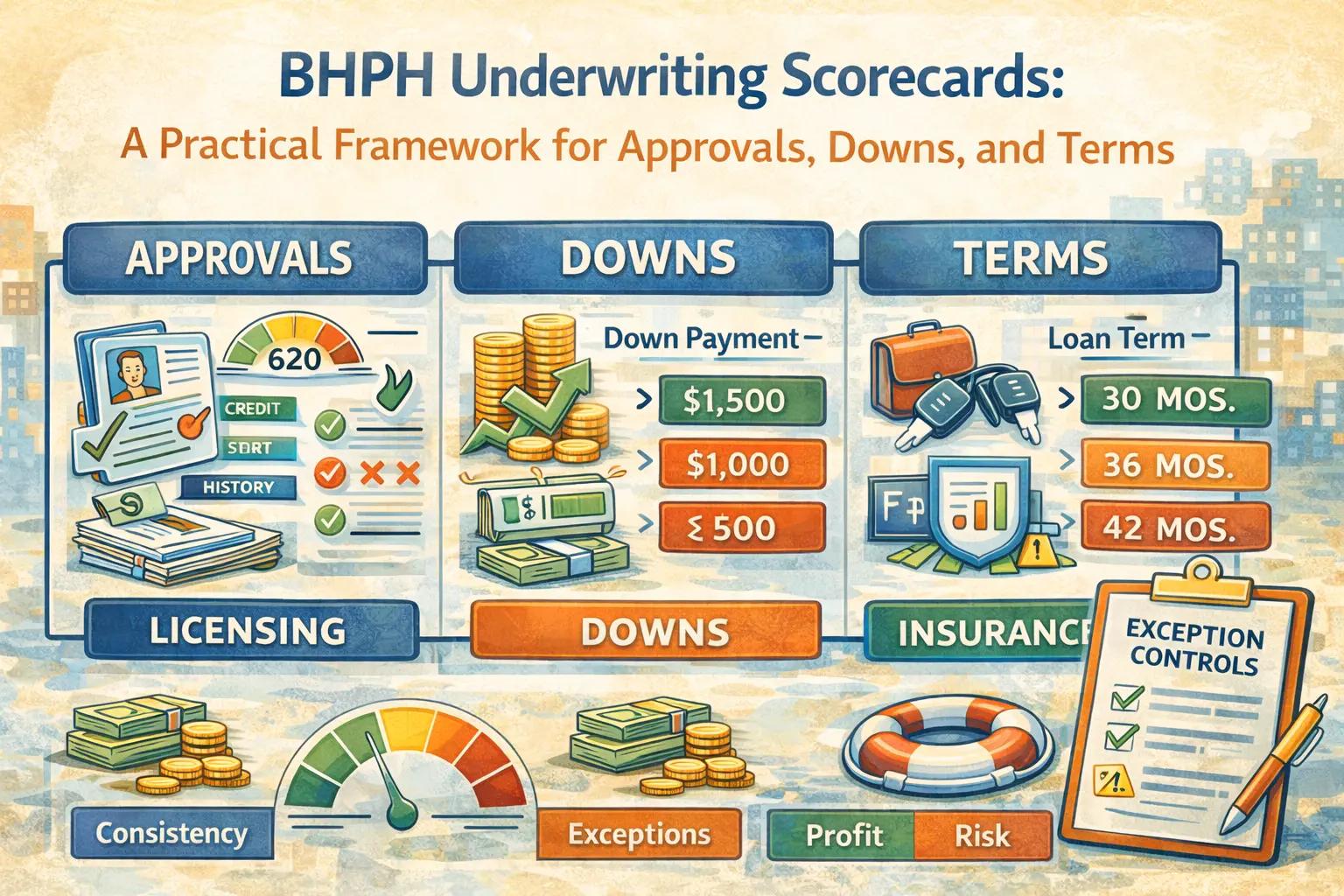
- Down Payment Tiers: Define minimum down payment requirements based on vehicle price, customer risk score, and credit history.
- Term Length Standards: Establish maximum term lengths based on vehicle age, mileage, and customer risk. Shorter terms generally mean less risk.
- Vehicle Age/Mileage Caps: Set clear limits for vehicles that can be included in a BHPH deal to manage asset risk and reconditioning costs.
- Payment Frequency Policy: Align payment frequency (weekly, bi-weekly, monthly) with the customer's income cycle to maximize payment success. For a detailed discussion on optimizing these policies, refer to our guide on BHPH Payment Policies.
Example: BHPH Underwriting Scorecard Approval Tiers
Below is a conceptual graph illustrating how a scorecard might segment applicants into different approval tiers, each with associated deal structure parameters. (Note: In a live blog, this would be a dynamic or static infographic, showing a matrix of risk scores (e.g., low, medium, high) against suggested down payment percentages and term lengths.)
4. Proof of Insurance Requirements and Coverage Tracking (Operational)
Ensure every financed vehicle is properly insured throughout the loan term.
- Requirements: Clearly communicate your minimum liability and physical damage insurance requirements to the customer.
- Tracking: Implement a system to verify proof of insurance at funding and to track continuous coverage, especially if using Lender's Single Interest (LSI) insurance.
5. Exceptions Policy (The Most Important Control)
Even with scorecards, exceptions are inevitable. A defined policy prevents arbitrary decisions.
- Who Can Approve Exceptions: Designate specific, trained individuals (e.g., general manager, finance director) who have authority to approve exceptions.
- Documentation Requirements: Mandate thorough documentation for every exception, detailing the rationale, mitigating factors, and additional terms (e.g., higher down payment).
- Audit Review Cadence: Regularly review all approved exceptions to identify trends, ensure compliance, and prevent policy drift.
6. Monitoring: Underwriting-to-Performance Feedback Loop
Continuously refine your scorecard based on real-world performance.
- Track Delinquency & Charge-Offs: Monitor how deals from different scorecard tiers or exception categories perform over time.
- Adjust Criteria: Use performance data to adjust scorecard weightings, deal structure rules, or exception policies, fostering continuous improvement.
How DealerClick Supports Standardized Underwriting and Visibility
DealerClick provides robust tools within its Buy Here Pay Here Dealer Software to support standardized BHPH underwriting. Our platform allows you to configure customizable scorecards, enforce deal structure rules, track proof of insurance, and manage exceptions with detailed documentation. The integrated reporting features provide real-time visibility into underwriting-to-performance metrics, empowering you to refine your policies and reduce risk. With DealerClick, you can ensure underwriting consistency, protect your profitability, and streamline your entire approval workflow.
Conclusion: Protecting Profit and Mitigating Risk Through Smart Underwriting
Consistent and objective underwriting is the cornerstone of a profitable and compliant Buy-Here Pay-Here dealership. By implementing practical scorecards, establishing clear rules for approvals, down payments, and terms, and integrating robust exception controls, dealers can move beyond subjective decisions to a data-driven approach. This not only safeguards gross profit and minimizes discrimination risk but also lays the foundation for a predictable and scalable portfolio.
Embrace standardized underwriting as a critical investment in your dealership's future. With the right framework and integrated technology, your BHPH operation can achieve a powerful balance of flexibility, profitability, and compliance.
Ready to implement a powerful BHPH underwriting scorecard framework?
Frequently Asked Questions (FAQs)
What is the primary purpose of a BHPH underwriting scorecard?
The primary purpose of a BHPH underwriting scorecard is to bring consistency and objectivity to the approval process. It uses a standardized set of criteria to assess applicant risk, ensuring deals are structured appropriately with adequate down payments and terms, thereby protecting gross profit and mitigating the risk of discriminatory lending.
How does income stability differ from current income in a BHPH scorecard?
While current income is important, income stability carries more weight in a BHPH scorecard. It refers to the predictability and duration of an applicant's earnings, considering factors like length of time at their current job, employment history, and consistent income sources. Stable income reduces the risk of missed payments over the loan term.
Why are "exception controls" so important in BHPH underwriting?
Exception controls are crucial because no scorecard can perfectly capture every unique applicant situation. A well-defined exception policy allows for flexibility in approving deals that might fall outside standard parameters, but only under strict, documented conditions. This prevents arbitrary decisions, reduces discrimination risk, and ensures such deals are properly reviewed and tracked.
How does a BHPH underwriting scorecard help reduce discrimination risk?
By establishing clear, objective, and consistently applied criteria, a BHPH underwriting scorecard minimizes the role of subjective judgment in lending decisions. This transparency and standardization help ensure that all applicants are evaluated based on the same factors, significantly reducing the potential for unconscious bias and allegations of discrimination.
How can DealerClick enhance BHPH underwriting processes?
DealerClick offers customizable tools to build and implement BHPH underwriting scorecards directly within its dealer software. It helps enforce deal structure rules, automates eligibility checks, and provides a platform for documenting exceptions. Integrated reporting allows dealers to monitor underwriting-to-performance feedback loops, enabling continuous refinement of policies for optimal profitability and compliance.
Stay Updated
Get the latest auto dealer insights delivered straight to your inbox.
No spam. Unsubscribe anytime.