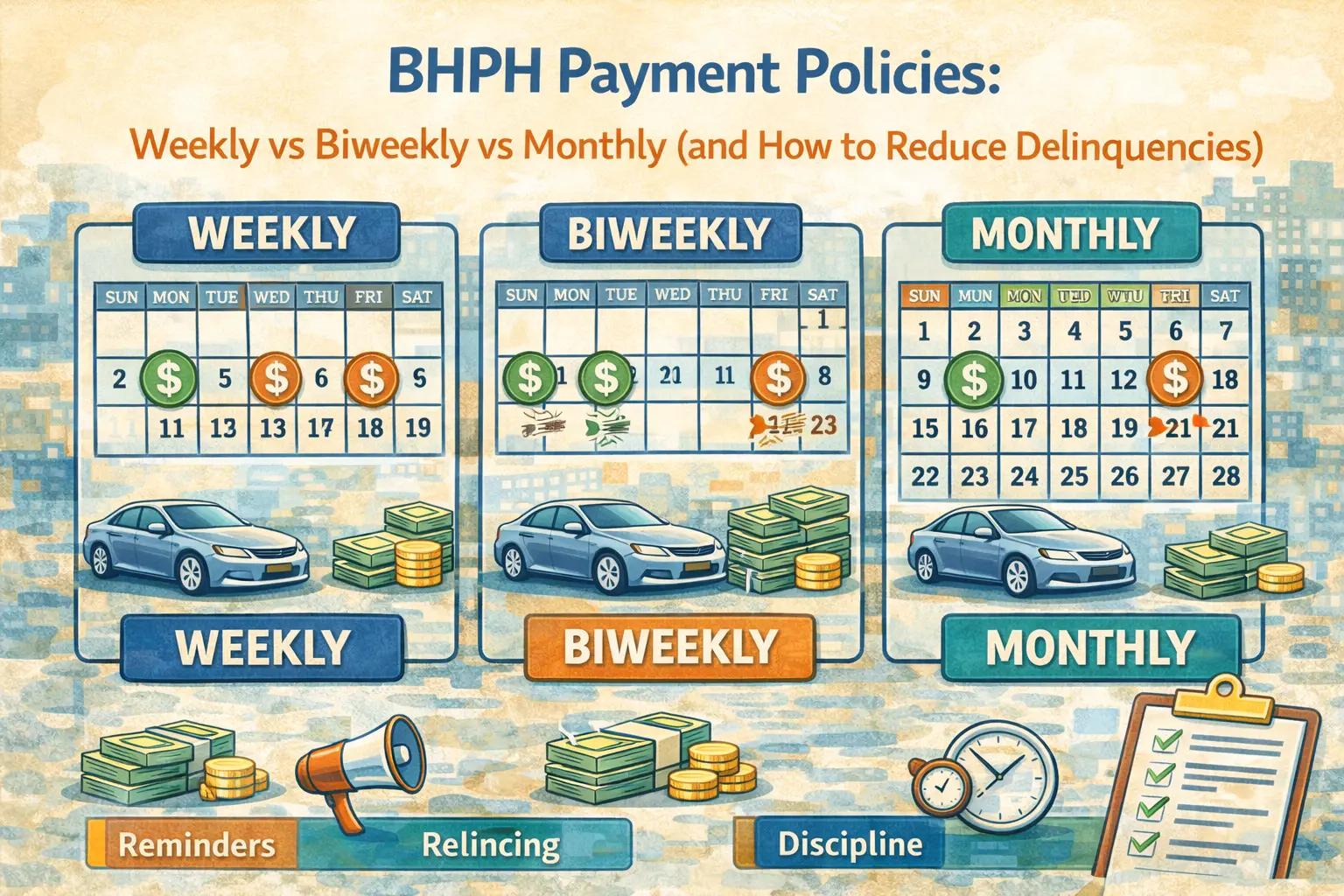
BHPH Payment Policies: Weekly vs Biweekly vs Monthly (and How to Reduce Delinquencies)
Payment frequency should directly align with customer paycheck realities. Discover how the right BHPH policy improves cash flow and lowers delinquency, provided your reminders and posting are disciplined.
In the cash-flow dependent world of Buy-Here Pay-Here (BHPH) dealerships, payment policies are far more than just administrative rules; they are a critical strategic lever. The choice of payment frequency—weekly, biweekly, or monthly—can dramatically impact customer success, cash flow predictability, and, ultimately, your delinquency rates. For a complete blueprint on launching a successful BHPH operation, including foundational insights into every operational aspect, refer to our pillar post: "Launching a Buy Here Pay Here Dealership: Complete Blueprint". This article delves into the strategic considerations behind BHPH payment policies, exploring how aligning with customer paycheck realities can improve cash flow and significantly reduce delinquencies, provided your reminders and posting processes are rigorously disciplined.
The Problem: Misaligned Payment Frequencies and Escalating Delinquencies
A common pitfall in Buy-Here Pay-Here (BHPH) operations is a disconnect between payment frequency policies and the economic realities of the customer base. Assuming a "standard" monthly payment schedule, often adopted from traditional finance models, can lead to chronic delinquency and cash-flow instability for dealers and customers alike. This misalignment results in:
- Increased Delinquency Rates: If payments are due weekly but customers are paid biweekly, or vice-versa, the mismatch can easily lead to missed payments and a spiraling cycle of delinquency.
- Cash Flow Instability: Irregular payment patterns create unpredictable cash flow for the dealership, making financial planning and reserve management challenging.
- Higher Collections Costs: Dealers spend more time and resources chasing payments, diverting valuable staff time from sales or other strategic activities.
- Customer Stress and Churn: Customers struggling to align payment due dates with their income cycles experience increased stress, leading to frustration, account defaults, and premature vehicle returns.
- Ineffective Reminders: A payment policy that doesn't fit a customer's pay cycle renders even the best reminder systems less effective, as the fundamental issue is timing, not memory.
These issues highlight why payment frequency is a strategic decision that demands careful consideration, rather than a mere preference.
The Solution: Strategic Payment Frequency Aligned with Customer Pay Cycles
The solution to reducing delinquencies and improving cash flow in BHPH lies in a strategic alignment of payment frequencies with the paycheck realities of your customer base. By understanding and matching weekly, biweekly, or monthly payment schedules to how your customers actually receive their income, dealerships can significantly enhance payment consistency and customer success. This "paycheck-centric" approach fosters financial stability for both the customer and the dealership, reducing friction and optimizing the entire collections process.
Implementing a payment policy tailored to your market's pay cycles, backed by disciplined reminders and accurate posting, transforms payment management from a reactive struggle into a proactive system that minimizes delinquencies. This not only secures cash flow but also builds a stronger, more trusting relationship with customers by making payments easier and more predictable. It's a fundamental step towards a resilient and profitable BHPH operation.
Key Benefits of Optimized BHPH Payment Policies
Strategically optimizing your BHPH payment policies delivers numerous advantages:
- Reduced Delinquency Rates: Aligning payment due dates with customer paychecks significantly lowers the likelihood of missed payments, directly impacting delinquency.
- Improved Cash Flow Predictability: Consistent payment inflows lead to more stable and predictable cash flow, enabling better financial planning and operational efficiency.
- Lower Collections Costs: Fewer delinquent accounts mean less time and resources spent on collections, freeing up staff for higher-value activities.
- Enhanced Customer Success & Retention: Easier and more predictable payment schedules reduce customer stress, leading to greater satisfaction, fewer defaults, and higher retention rates.
- Stronger Portfolio Performance: A healthier portfolio with lower delinquency contributes to higher overall yield and better returns on your investments.
- Streamlined Operations: Consistent payment patterns simplify reconciliation and reporting, reducing administrative burden and errors.
- Better Risk Management: Understanding and responding to customer payment behaviors allows for more proactive risk management across your portfolio.
How It Works: Crafting Your BHPH Payment Frequency Strategy
Crafting an effective BHPH payment policy involves analyzing your customer base, understanding the tradeoffs of different frequencies, and implementing disciplined operational processes.
1. Why Payment Frequency Is a Strategy Decision (Not a Preference)
Payment frequency directly impacts your customers' ability to pay, your dealership's cash flow, and your operational load. It should be a deliberate choice based on market research (as discussed in our guide on BHPH Market Research: Find the Right Niche, Payment Range, and Inventory Mix) and portfolio performance, not an arbitrary decision.
2. Matching Pay Cycles: Wage vs. Benefits vs. Gig Income
Tailor your payment options to your customers' primary income sources:
- Wage Earners: Often paid weekly or biweekly. Offering corresponding payment frequencies can dramatically improve success rates.
- Benefit Recipients: Payments might be monthly (e.g., social security, disability). Monthly options are appropriate here.
- Gig Economy Workers: Income can be highly variable. More frequent, smaller payments might be easier to manage, or flexible payment arrangements may be needed.
3. Weekly vs. Biweekly vs. Monthly: Tradeoffs
Each payment frequency has distinct implications:
- Weekly Payments:
- Customer Success Probability: High, aligns with frequent paychecks. Easier for customers to budget smaller amounts.
- Operational Load: Highest, requires more frequent processing and reconciliation.
- Cash Consistency: Most consistent cash flow for the dealership.
- Biweekly Payments:
- Customer Success Probability: High, aligns with common biweekly paychecks.
- Operational Load: Moderate, less frequent than weekly but more than monthly.
- Cash Consistency: Good, predictable cash flow.
- Monthly Payments:
- Customer Success Probability: Lower for many subprime customers as budgeting larger sums over longer periods can be challenging.
- Operational Load: Lowest.
- Cash Consistency: Least consistent, larger gaps between inflows.
Example: Delinquency Rates by Payment Frequency
Below is a conceptual graph illustrating how delinquency rates might vary across different payment frequencies for a typical BHPH portfolio. (Note: In a live blog, this would be a dynamic or static infographic, showing bar charts or line graphs comparing delinquency percentages for weekly, biweekly, and monthly payments.)
4. Autopay Enrollment and Customer Education
Promoting autopay and educating customers are crucial for any payment frequency.
- Autopay Incentives: Encourage enrollment in autopay through clear communication of benefits and potentially small incentives.
- Onboarding Education: During the onboarding process, clearly explain the chosen payment frequency, due dates, and the benefits of sticking to the schedule.
5. Payment Posting Discipline and Reconciliation Basics
Regardless of frequency, accuracy and timeliness in processing payments are non-negotiable.
- Automated Posting: Leverage technology to automate payment posting to minimize errors.
- Daily Reconciliation: Reconcile payments daily to catch discrepancies early.
- Clear Reporting: Ensure your system provides clear reports on payment statuses and exceptions.
6. Reducing Delinquencies Through Policy + Process
Beyond frequency, effective policies reduce delinquencies:
- Grace Periods: Clearly define and consistently apply grace periods.
- Late Fees: Communicate late fees transparently and apply them consistently.
- Reminder Systems: Implement automated and human-led reminder systems to prompt customers before and after payment due dates. For a detailed framework on managing delinquent accounts, refer to our BHPH Collections SOP.
How DealerClick Supports Recurring Payments and Payment Visibility
DealerClick provides a powerful, integrated solution within its Buy Here Pay Here Dealer Software to manage BHPH payment policies effectively. Our system facilitates easy setup of weekly, biweekly, or monthly recurring payments, automates reminders, and ensures accurate payment posting and reconciliation. With comprehensive payment visibility and reporting features, DealerClick empowers you to analyze payment performance, track delinquency trends, and optimize your policies for improved cash flow and reduced risk. Additionally, our auto dealer CRM features assist in customer education and communication regarding payment terms.
Conclusion: Driving BHPH Success with Strategic Payment Policies
The strategic choice of payment frequency, meticulously aligned with your customer's paycheck realities, is a cornerstone of a profitable and resilient Buy-Here Pay-Here dealership. Moving beyond generic approaches to implementing disciplined policies for weekly, biweekly, or monthly payments, supported by robust autopay and reminder systems, can dramatically reduce delinquencies and stabilize cash flow. This proactive approach transforms payment management from a reactive struggle into a powerful lever for customer success and dealership growth.
Embrace payment policy optimization as a continuous process, driven by data and focused on your customers' financial well-being. With the right strategy and integrated tools, your BHPH operation can achieve unparalleled payment consistency and sustainable profitability.
Ready to optimize your BHPH payment policies for reduced delinquencies and improved cash flow?
Frequently Asked Questions (FAQs)
What is the ideal payment frequency for a BHPH dealership?
There is no single "ideal" payment frequency; it depends on your target market's pay cycles. For many subprime customers, aligning payments with weekly or biweekly paychecks often leads to better payment consistency and lower delinquency compared to monthly payments, as it's easier for them to budget smaller, more frequent amounts.
How can BHPH dealers encourage autopay enrollment?
Dealers can encourage autopay enrollment by clearly communicating its benefits (e.g., convenience, avoiding late fees) during the sales process. Offering small incentives, such as a slightly reduced payment or a waiver of an administrative fee, can also boost enrollment. Ensuring the autopay setup process is simple and transparent is key.
What are the operational challenges of weekly payments for BHPH?
While weekly payments can improve customer success and cash flow, they also impose the highest operational load on the dealership. This includes more frequent processing of payments, increased reconciliation tasks, and a higher volume of reminders. A robust Dealer Management System (DMS) with strong automation is essential to manage this load efficiently.
How does payment posting discipline impact BHPH financial health?
Meticulous payment posting discipline is crucial for BHPH financial health. Accurate and timely posting ensures that customer accounts are correctly updated, prevents disputes, and provides a real-time view of cash flow and delinquency. Errors in posting can lead to miscalculations of revenue, incorrect collections actions, and ultimately, financial instability.
Can DealerClick adapt to different BHPH payment frequencies?
Yes, DealerClick is designed to support various BHPH payment frequencies, including weekly, biweekly, and monthly. Its integrated platform allows dealers to easily configure recurring payment schedules, automate reminders, and manage accurate payment posting and reconciliation for all frequencies. This flexibility helps dealers align with customer needs and optimize their payment policies.
Stay Updated
Get the latest auto dealer insights delivered straight to your inbox.
No spam. Unsubscribe anytime.