
Powersports vs. Automotive DMS: Why Specialized Software is Non-Negotiable
Many dealers try to force an automotive DMS to work for powersports. This creates expensive workarounds, frustrated staff, and lost revenue. Here's why the unit vs. VIN logic and parts supersession needs are fundamentally different.
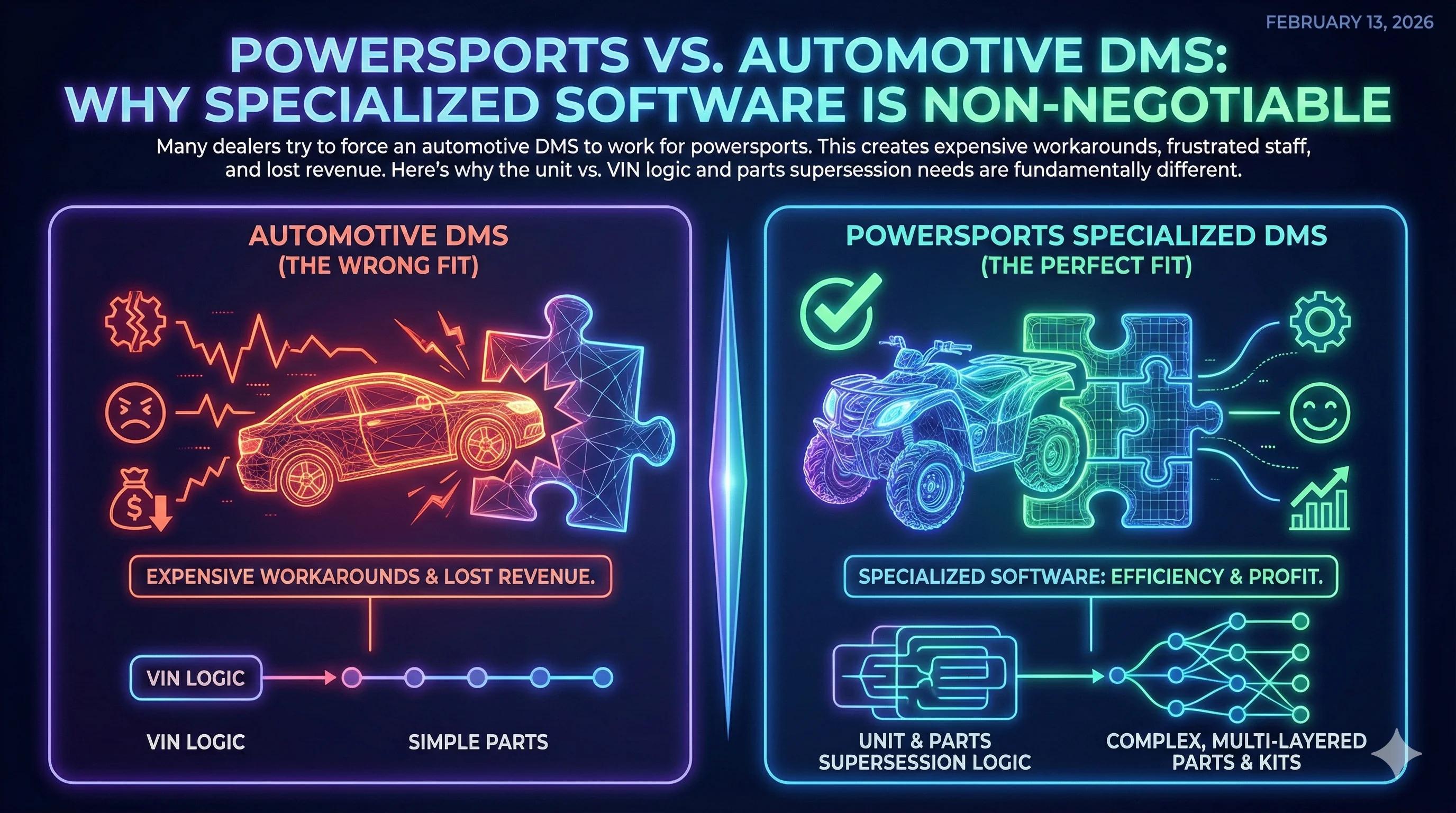
The "we'll just use our automotive DMS for powersports" decision seems logical on the surface—leverage existing software, avoid learning curves, save on implementation costs. But this square-peg-round-hole approach creates compounding operational friction that costs dealers far more than dedicated software would. Modern powersports dealer management software addresses fundamental differences between automotive and powersports retail that generic automotive systems simply cannot handle efficiently.
The distinction isn't cosmetic—it's structural. Powersports dealerships manage dramatically different inventory complexity (50,000+ parts SKUs versus 5,000 for automotive), sell multiple major units in single transactions (ATV + trailer + accessories), navigate fundamentally different OEM relationships (weekly price book updates from 6+ manufacturers), and handle service work that defies flat-rate labor standards. Automotive DMS platforms were designed for VIN-centric single-vehicle transactions with standardized parts fitment and predictable service intervals.
This guide explains the specific operational areas where automotive DMS platforms fail powersports dealers, quantifies the cost of workarounds and inefficiency, and demonstrates why specialized powersports software isn't a luxury—it's an operational necessity for dealers serious about profitability.
The "Square Peg, Round Hole" Problem: Why Auto DMS Fails the Powersports Dealer
Automotive DMS platforms evolved to solve automotive retail challenges: managing VIN-specific vehicle data, tracking single-unit sales transactions, handling predictable service intervals, and navigating relatively stable manufacturer relationships. Powersports retail operates under fundamentally different constraints that automotive software was never designed to address.
The Core Architecture Mismatch
Automotive DMS platforms are built around the VIN as the central organizing principle. Every transaction, every service ticket, every parts order ties back to a specific 17-character VIN that uniquely identifies the vehicle, its specifications, and its service history.
Powersports inventory doesn't work this way:
Automotive DMS assumption: One VIN = one vehicle = one transaction Powersports reality: One deal = ATV + trailer + helmet + protective gear + extended warranty + financing across multiple manufacturers
An automotive system asks "what vehicle are we selling?" A powersports system must ask "what combination of major units, accessories, and protection products is this customer buying, and how do we track inventory, commissions, F&I products, and manufacturer floor plan across 6 different items with 4 different manufacturers?"
The Multi-Unit Deal Problem: A typical powersports deal might include a Polaris RZR ($28,000), a trailer from a different manufacturer ($3,500), riding gear ($800), an extended warranty, gap insurance, and financing. That's 6+ line items across 3 manufacturers with different floor plan lenders, different commission structures, and different inventory tracking needs—all in a single transaction. Automotive DMS treats this as chaos. Powersports DMS treats it as Tuesday.
The Workaround Tax
Dealers using automotive DMS for powersports resort to elaborate workarounds to make the software function:
Common workarounds and their costs:
- Multiple "vehicles" per deal: Creating separate records for ATV, trailer, and accessories inflates transaction counts, breaks reporting accuracy, and complicates commission tracking
- Manual parts lookup: Without manufacturer-specific parts integration, service advisors spend 5-10 extra minutes per RO manually searching parts catalogs
- Spreadsheet inventory management: Running parallel systems in Excel to track what the DMS can't handle properly
- Duplicate data entry: Manually entering information the DMS should auto-populate from manufacturer integrations
- Custom fields gone wild: Creating dozens of custom fields to force-fit powersports data into automotive schemas
"We tried using our automotive DMS for our new powersports division. Within three months, staff were maintaining two Excel spreadsheets, a paper logbook for accessories, and still couldn't get accurate inventory reports. The 'cost savings' from avoiding new software was costing us 15-20 hours per week in manual workarounds." — Multi-Brand Dealership General Manager
These workarounds don't just waste time—they create data quality problems, inventory discrepancies, and compliance risks that compound over time.
The Employee Frustration Factor
Staff trained on purpose-built systems become immediately frustrated when forced to use inappropriate tools. Service advisors accustomed to instant parts lookup see 10-minute manual searches as broken systems. Sales staff who should close deals in 45 minutes spend 90 minutes fighting software that wasn't designed for multi-unit transactions.
This frustration manifests as:
- Higher employee turnover (trained staff leave for dealerships with proper systems)
- Reduced productivity (staff spend time fighting software rather than serving customers)
- Increased error rates (workarounds create opportunities for mistakes)
- Lower morale (talented people resent being given inadequate tools)
The "cost savings" from using automotive DMS evaporates quickly when you factor in turnover, retraining, and productivity losses.
The Parts Problem: Handling 50,000+ SKUs and Year/Make/Model Fitment vs. Simple Auto VINs
Parts inventory and management represents perhaps the starkest difference between automotive and powersports operations. The complexity gap isn't incremental—it's exponential.
The Scale Difference
Automotive dealership (single brand, typical):
- 5,000-8,000 active parts SKUs
- VIN-based fitment (parts lookup tied to specific vehicle VIN)
- Single manufacturer parts system
- Predictable supersession (manufacturer handles discontinued parts)
- Standardized pricing updates (monthly or quarterly)
Powersports dealership (multi-brand, typical):
- 40,000-60,000 active parts SKUs
- Year/make/model fitment (parts fit multiple units with complex compatibility)
- 4-8 different manufacturer parts systems
- Aggressive supersession cycles (parts obsolete within 2-3 years)
- Weekly pricing updates from multiple OEMs
- Aftermarket parts integration (performance upgrades, accessories)
Parts Complexity Reality: A powersports dealer carrying Yamaha, Polaris, Honda, and Kawasaki manages more parts SKUs than a Ford dealership manages for all vehicles sold in the last 20 years. And those SKUs change faster—what fits a 2024 YZ450F might not fit a 2025 model, and the parts supersede twice as fast as automotive components.
The Fitment Challenge
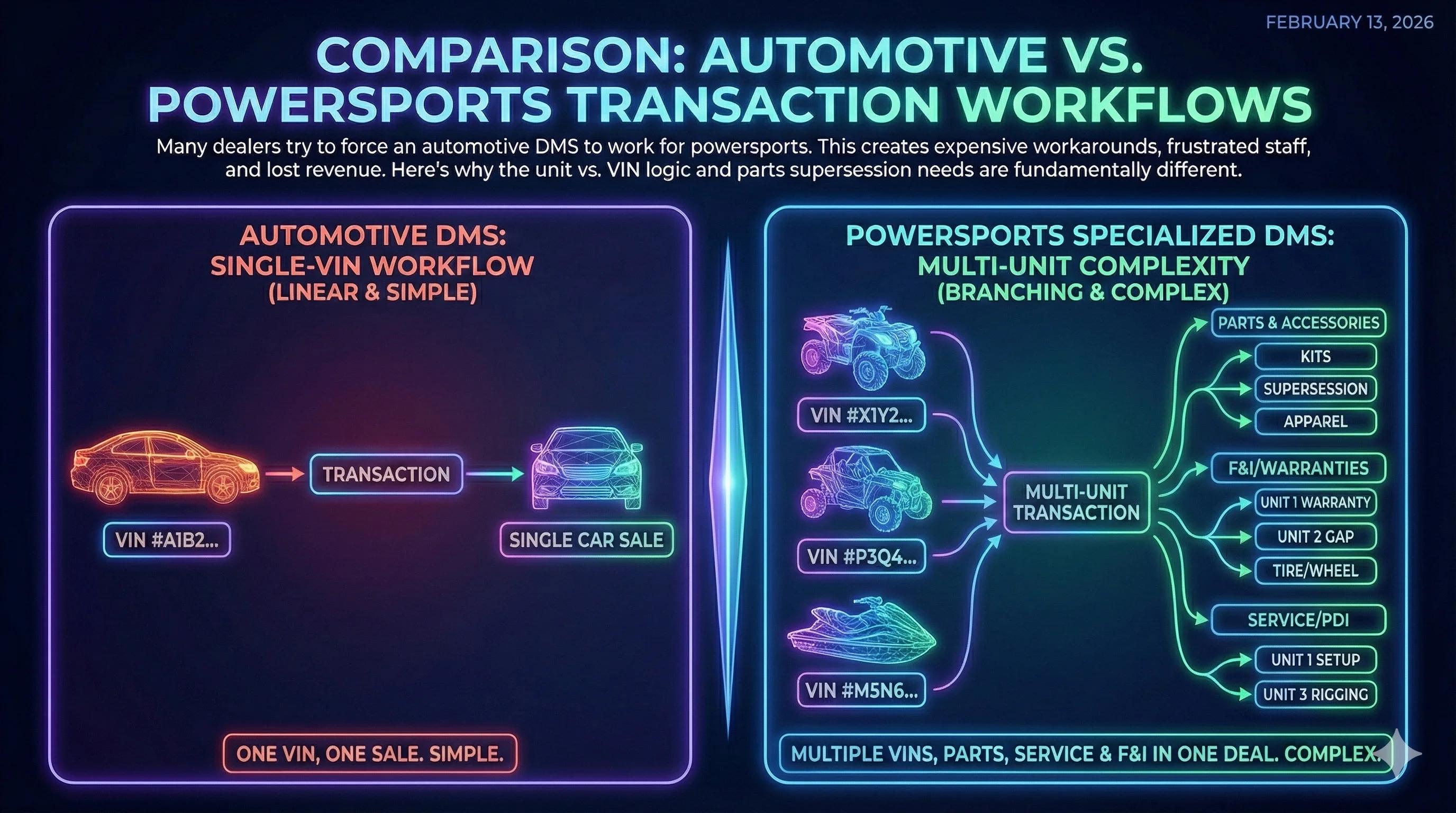
Automotive VIN-based parts lookup is elegant: scan VIN, system knows exactly which parts fit. Powersports fitment is complex: a single brake pad SKU might fit 47 different ATV models across 3 manufacturers and 8 model years—but only if specific wheel configurations are present.
Automotive parts lookup:
- Scan VIN
- System identifies exact vehicle specifications
- System shows compatible parts
- Service advisor selects part
Powersports parts lookup (without proper DMS):
- Identify year/make/model/trim/configuration
- Manually search manufacturer catalog
- Cross-reference fitment guide
- Verify supersession status (is this part discontinued?)
- Check multiple manufacturers for compatible alternatives
- Verify pricing hasn't changed since last week
- Confirm inventory quantity
- Finally add to service ticket
This 7-step process takes 8-12 minutes without powersports-specific DMS. With proper integration, it takes 45 seconds.
Pro Tip: Track "parts lookup time per RO" as a metric. If your service advisors average more than 2 minutes per parts lookup, your DMS is costing you billable hours. At 5 lookups per RO and 200 ROs per month, reducing lookup time from 10 minutes to 1 minute saves 90 hours per month—equivalent to a full-time technician's productivity.
The Supersession Problem
Automotive parts supersession happens gradually—a part discontinued in 2026 likely has years of replacement inventory available. Powersports supersession is aggressive—manufacturers discontinue parts for 2-3 year old models routinely, and finding replacements requires extensive cross-referencing.
Automotive DMS handles supersession passively: when ordering discontinued part ABC123, system suggests replacement DEF456.
Powersports requires active supersession management:
- Weekly supersession file imports from 4-8 manufacturers
- Cross-manufacturer compatibility checking
- Aftermarket alternative identification
- Inventory purging for obsolete parts (preventing dead stock accumulation)
- Customer communication (parts on backorder, no longer available)
Without powersports-specific DMS, this supersession management happens manually—if it happens at all. Most dealers using automotive systems discover parts are discontinued only after attempting to order them, creating service delays and customer frustration.
The Inventory Obsolescence Cost
Poor parts supersession management leads directly to inventory obsolescence. Automotive dealerships typically carry 3-5% obsolete parts inventory (parts sitting 12+ months with no movement). Powersports dealerships using automotive DMS average 12-18% obsolete inventory because the system doesn't flag superseded parts proactively.
Obsolescence cost example:
- Average powersports dealer: $400,000 parts inventory
- 15% obsolescence rate: $60,000 in dead inventory
- Reduction to 5% with proper DMS: $20,000 dead inventory
- Annual savings from avoiding obsolescence: $40,000
That $40,000 annual savings alone pays for specialized powersports DMS—and that's just one benefit category.
| Parts Management Feature | Automotive DMS | Powersports DMS | Impact |
|---|---|---|---|
| Active SKUs supported | 5,000-8,000 | 40,000-60,000+ | 8x inventory capacity |
| Parts lookup method | VIN-based only | Y/M/M + cross-compatibility | Universal fitment search |
| Avg lookup time | 8-12 minutes (manual) | 45 seconds (integrated) | 93% faster |
| Supersession updates | Manual or monthly | Automated weekly imports | Current data always |
| Multi-manufacturer support | Single OEM focus | 4-8+ OEM simultaneous | Multi-brand native |
| Obsolescence rate | 12-18% | 3-5% | $40K annual savings |
Major Units vs. Vehicles: Managing ATVs, UTVs, Trailers, and Accessories in a Single "Deal"
The transaction structure difference between automotive and powersports retail creates fundamental software architecture requirements that automotive DMS simply cannot meet.
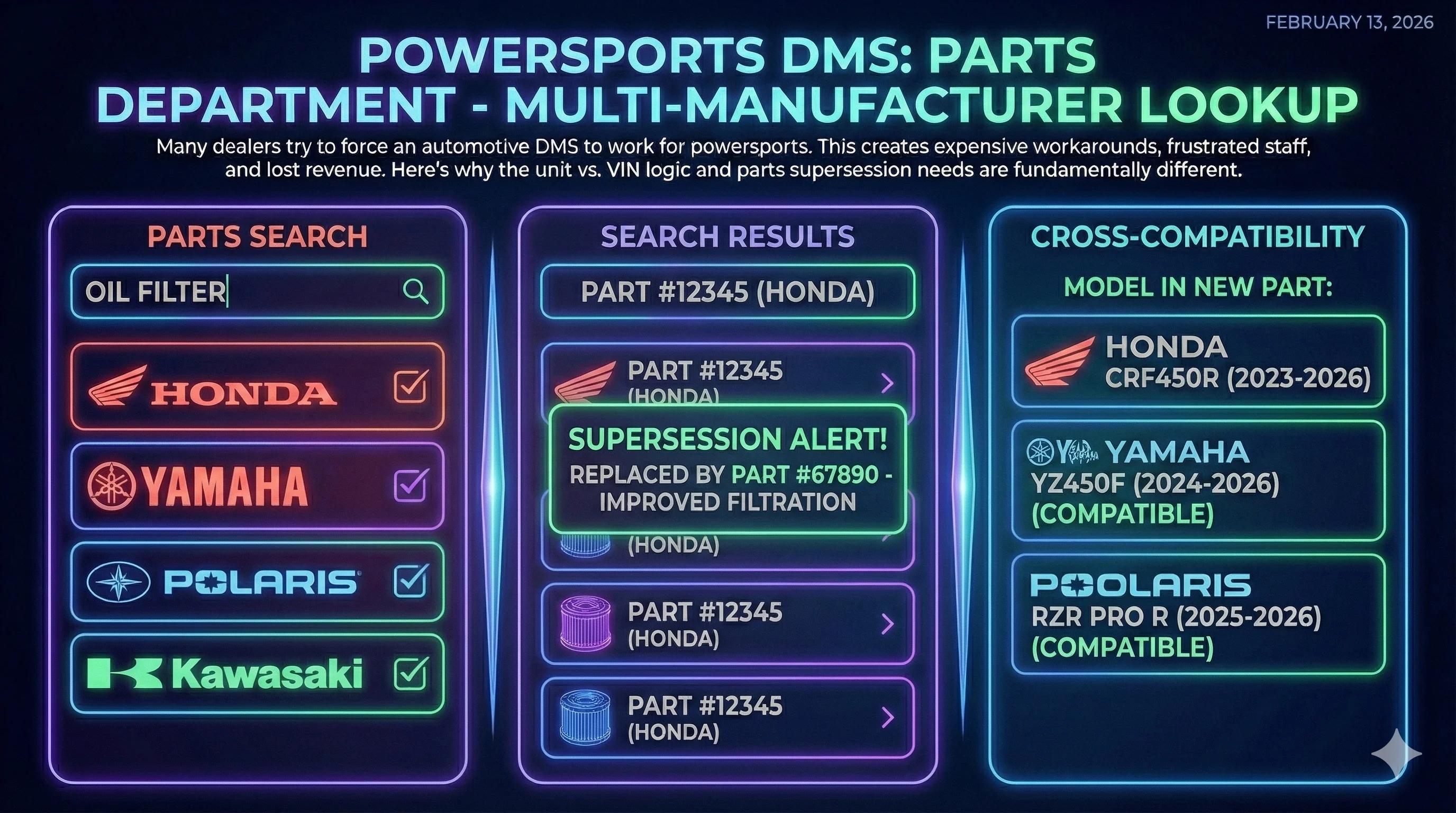
The Single vs. Multi-Unit Transaction Model
Automotive deal structure:
- One vehicle
- Optional trade-in (one vehicle)
- F&I products tied to the single vehicle
- Simple commission calculation (single unit)
- Single manufacturer floor plan
Powersports deal structure:
- Primary unit (ATV, UTV, motorcycle, etc.)
- Trailer (different manufacturer, separate floor plan)
- Helmet, protective gear, accessories (different manufacturer or aftermarket)
- Performance upgrades installed during PDI
- Extended warranty (might cover only primary unit)
- Gap insurance (covers financed amount across all units)
- Financing that bundles everything
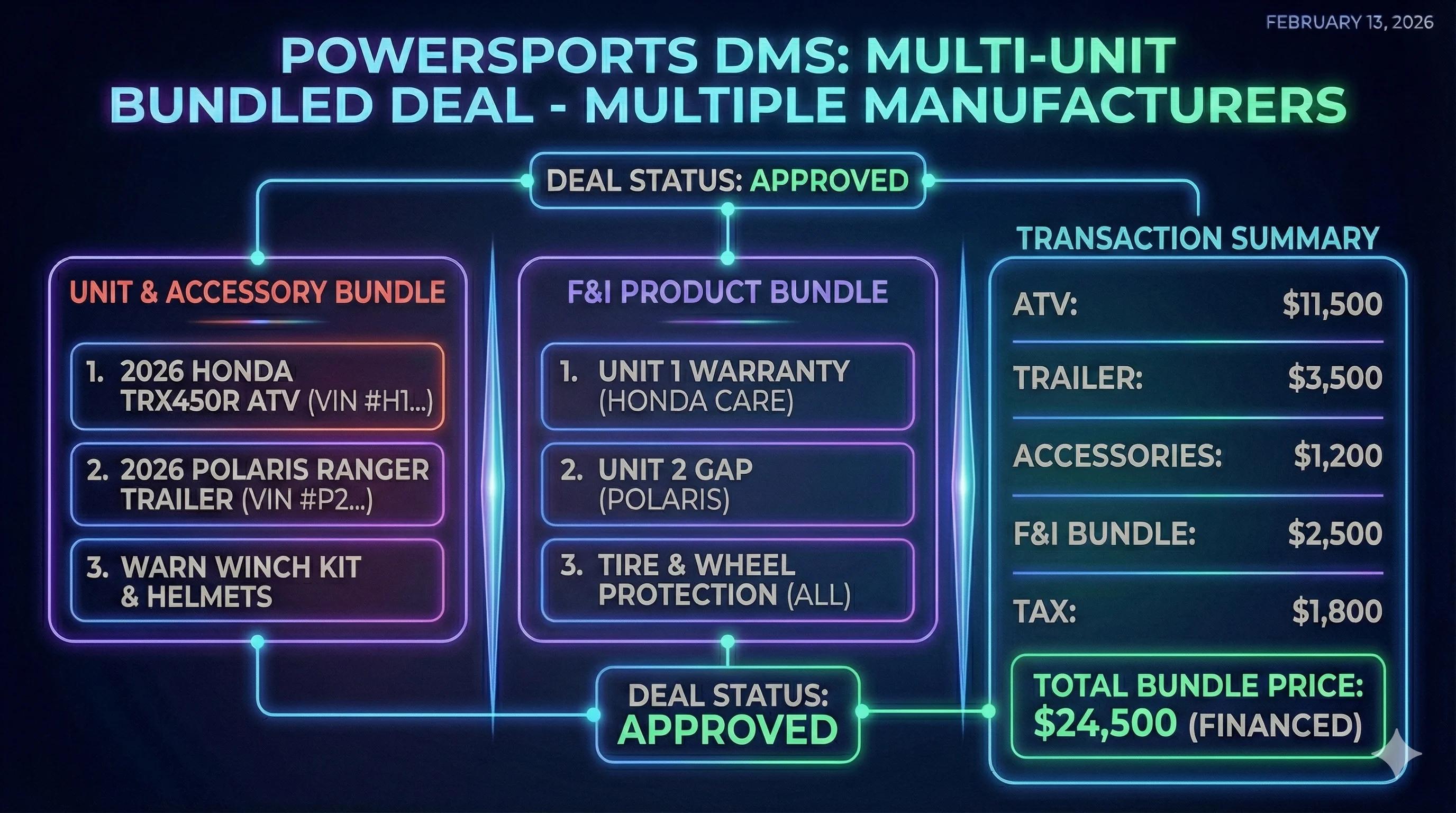
Real-World Example: Customer buys Honda Talon UTV ($24,000 on Honda floor plan), Aluma trailer ($3,200 on separate floor plan), Fox riding gear bundle ($950 cash purchase), and winch installation ($600 parts + labor). F&I adds extended warranty ($1,800) and gap insurance ($650). Total deal: $31,200 across three different inventory systems, two floor plan lenders, and four different manufacturer commission structures. How does automotive DMS handle this? It doesn't—not elegantly.
The Commission Nightmare
Automotive commission structures are straightforward: percentage of gross profit on vehicle sale, percentage of F&I income, flat bonus for volume targets.
Powersports commissions are complex:
- Different commission rates per manufacturer
- Spiffs on specific models (manufacturer-funded bonuses)
- Accessory commission different from unit commission
- Installation labor commission different from parts commission
- F&I commission calculated on total deal or per-product
- Team splits (who gets credit when multiple salespeople involved?)
Automotive DMS calculates commissions assuming single-unit sales with simple percentage models. Powersports dealers resort to manual commission calculation spreadsheets because the DMS can't handle the complexity.
Commission calculation time:
- Automotive DMS: Automatic, instant
- Powersports on automotive DMS: 15-20 minutes manual calculation per deal
- Powersports on proper DMS: Automatic, instant (with multi-manufacturer rules engine)
At 150 deals per month, that's 37-50 hours of manual commission calculation monthly—nearly the equivalent of a full-time employee just calculating commissions that should be automated.
Floor Plan Management Across Multiple Lenders
Automotive dealers typically work with one floor plan lender for their single-brand inventory. Powersports dealers work with multiple:
- Polaris units financed through Polaris credit subsidiary
- Yamaha units through Yamaha Motor Finance
- Trailers through Equipment Finance Company
- Used units through NextGear or similar
- Accessories purchased with cash (no floor plan)
When completing a sale, the system must:
- Identify which floor plan lender holds each unit
- Generate proper curtailment packets for each lender
- Calculate accurate payoff amounts (floor plan interest accrued)
- Allocate customer payment across floor plan payoffs
- Track which items remain on floor plan vs. owned free-and-clear
Automotive DMS assumes single floor plan lender. Powersports dealers manually track floor plan payoffs across multiple lenders—creating opportunities for errors, delayed curtailments, and unnecessary interest expense.
Floor Plan Interest Waste: Manual floor plan management leads to delayed curtailments. A unit sold on the 5th of the month might not get curtailed until the 20th because paperwork sat waiting for manual processing. That 15-day delay on a $25,000 unit costs $85 in unnecessary floor plan interest (at 8.5% annual rate). Multiply by 100 units per month = $8,500 monthly waste, $102,000 annually—just from delayed curtailments that automated systems prevent.
Inventory Tracking Complexity
Automotive inventory is binary: on lot or sold. Powersports inventory has multiple states across different categories:
Major units: On floor plan, available, sold (pending curtailment), consignment, demo, rental fleet Accessories: In stock, committed to pending deals, installed on units, back-ordered Trailers: On separate floor plan, might be drop-shipped directly to customer Clothing/helmets: Size/color matrix (12 helmet models × 4 sizes × 6 colors = 288 SKUs for helmets alone)
Automotive DMS tracks VINs and their binary status. Powersports DMS must track complex inventory states across diverse categories with different replenishment models, different floor plan requirements, and different accounting treatment.
Pro Tip: If your staff maintains Excel spreadsheets alongside your DMS for any inventory category (accessories, clothing, trailers), your DMS isn't meeting your business needs. Every parallel system is a failure point where data goes out of sync and errors occur.
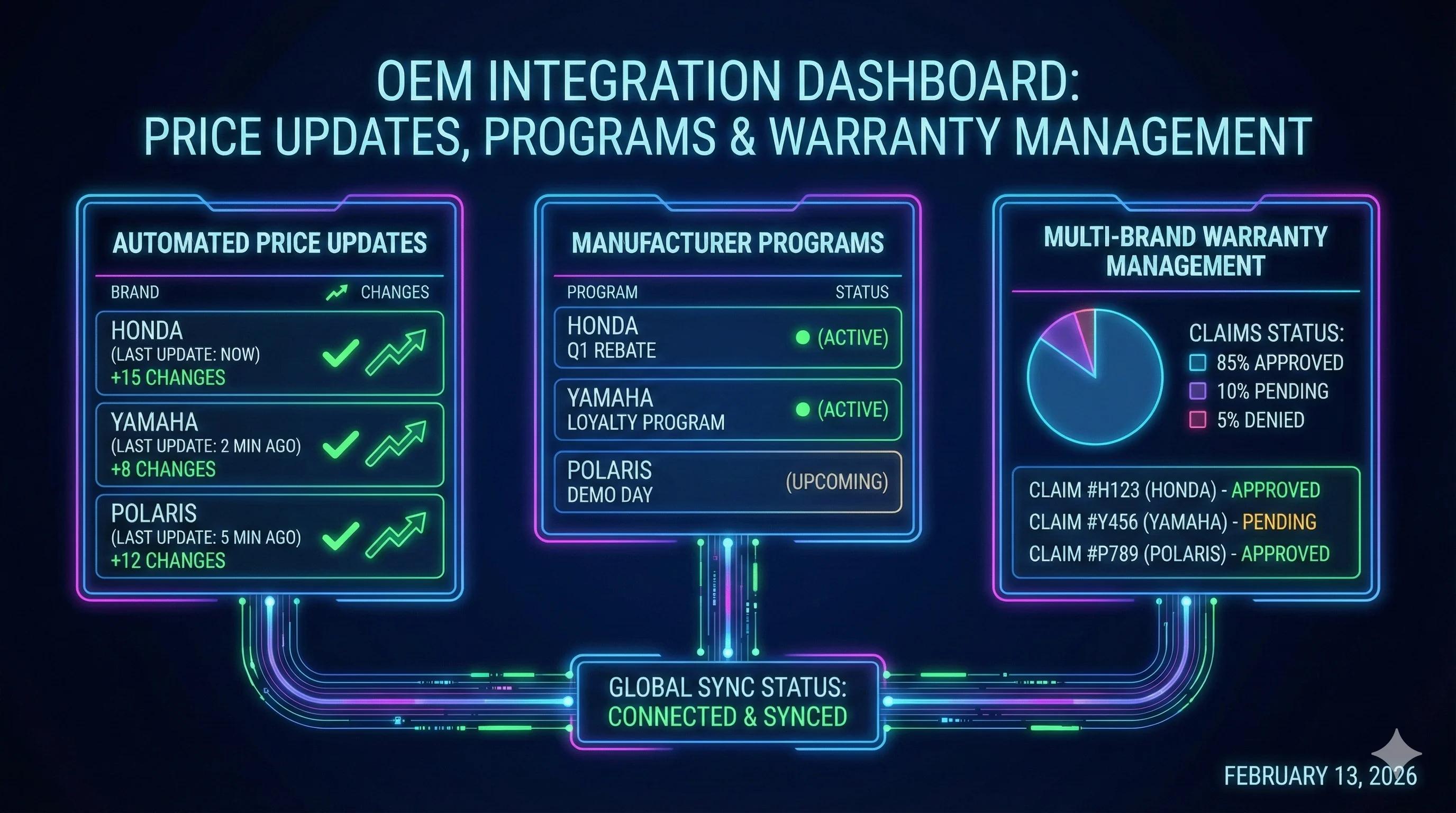
OEM Integration: Why Automated Price-Book Updates for Yamaha, Polaris, and BRP Are the "Killer Feature"
The relationship between dealers and manufacturers differs fundamentally between automotive and powersports industries, creating dramatically different software integration requirements.
The Automotive OEM Relationship Model
Automotive dealers typically sell one brand:
- Single OEM relationship
- Standardized data formats (all automotive manufacturers use similar systems)
- Stable pricing (MSRP changes quarterly or annually)
- Predictable inventory replenishment cycles
- Centralized parts distribution
This single-OEM model allows automotive DMS to deeply integrate with one manufacturer's systems and call it complete.
The Powersports Multi-OEM Reality
Powersports dealers typically carry 4-8 brands:
- 4-8 simultaneous OEM relationships
- Proprietary data formats (each manufacturer has different systems)
- Weekly pricing updates (especially for parts and accessories)
- Inconsistent inventory replenishment (some units allocated, others open-order)
- Decentralized parts distribution (regional vs. national warehouses)
Each manufacturer has different:
- Ordering systems and protocols
- Warranty claim processes and requirements
- Incentive program structures
- Marketing co-op fund management
- Floor plan financing terms
The Weekly Pricing Problem: Polaris might update parts pricing every Tuesday. Yamaha updates Thursdays. BRP updates Fridays. Honda updates sporadically. Without automated price-book imports, dealers manually update prices (impossible to do weekly), or they don't update at all—leading to quoted prices that don't match actual costs, destroying margin or creating customer disputes.
The Cost of Manual Price Management
Without automated OEM integration, powersports dealers face weekly choices:
Option 1: Manually update all price books Time required: 4-6 hours per manufacturer × 6 manufacturers = 24-36 hours weekly Cost: One full-time employee just managing price book updates Reality: No dealership does this—the labor cost is prohibitive
Option 2: Update periodically (monthly or quarterly) Result: Pricing data becomes stale within weeks Impact: Service quotes don't match actual costs, gross profit erodes, customer complaints increase
Option 3: Don't update price books Result: Quoted prices drift from actual costs Impact: Either over-quoting (losing sales) or under-quoting (losing margin) Long-term: Impossible to maintain profitability with incorrect pricing data
Option 4: Use specialized powersports DMS with automated OEM integration Process: Automated nightly imports from manufacturer price systems Staff time: Zero—completely automated Result: Always-current pricing, accurate quotes, protected margins
The choice isn't between convenience and inconvenience—it's between operational viability and failure.
Manufacturer Incentive and Program Management
Automotive manufacturers offer relatively straightforward incentive programs: volume bonuses, specific model promotions, financing incentives.
Powersports manufacturer programs are complex and constantly changing:
- Model-specific spiffs (changes weekly based on inventory levels)
- Regional promotions (different incentives by state or territory)
- Seasonal programs (spring rush incentives vs. fall closeouts)
- Accessory attachment bonuses (install X accessory, earn $Y)
- Floor plan credits (stock certain units, get interest credits)
- Marketing co-op funds with specific claiming requirements
Without automated integration, dealers:
- Miss incentive opportunities (didn't know program existed)
- Fail to claim earned incentives (forgot to submit documentation)
- Can't track program performance real-time (discover after month-end)
Specialized powersports DMS integrates manufacturer program data, automatically tracking eligibility and highlighting opportunities.
"We switched from automotive DMS to powersports-specific software. Within the first month, the automated manufacturer program tracking identified $12,000 in unclaimed incentives we'd earned but didn't know existed. The software paid for itself in 60 days just from found money." — Powersports Dealer Principal
Warranty Claims and Service Integration
Automotive warranty claims follow standardized processes across manufacturers. Powersports warranty claim requirements vary dramatically by manufacturer and require different documentation, approval processes, and reimbursement timelines.
Yamaha might require photos of failed components Polaris might require component return for inspection Honda might approve claims electronically within 24 hours BRP might require pre-approval before performing warranty work
Automotive DMS assumes standardized warranty processes. Powersports DMS must handle manufacturer-specific workflows, documentation requirements, and approval tracking across 4-8 different systems simultaneously.
The productivity difference is substantial: warranty claim submission with integrated DMS takes 5-8 minutes. Manual claim submission without integration averages 20-25 minutes—and often requires follow-up due to missing documentation or incorrect formats.
| OEM Integration Feature | Automotive DMS | Powersports DMS |
|---|---|---|
| Manufacturers supported | Single OEM | 4-8+ simultaneous |
| Price book updates | Quarterly (single source) | Weekly automated (all OEMs) |
| Incentive program tracking | Basic volume bonuses | Complex multi-OEM programs |
| Warranty claim workflow | Standardized process | Manufacturer-specific routing |
| Parts ordering integration | Single OEM system | Multi-OEM consolidated |
| Floor plan curtailment | Single lender automated | Multi-lender routing |
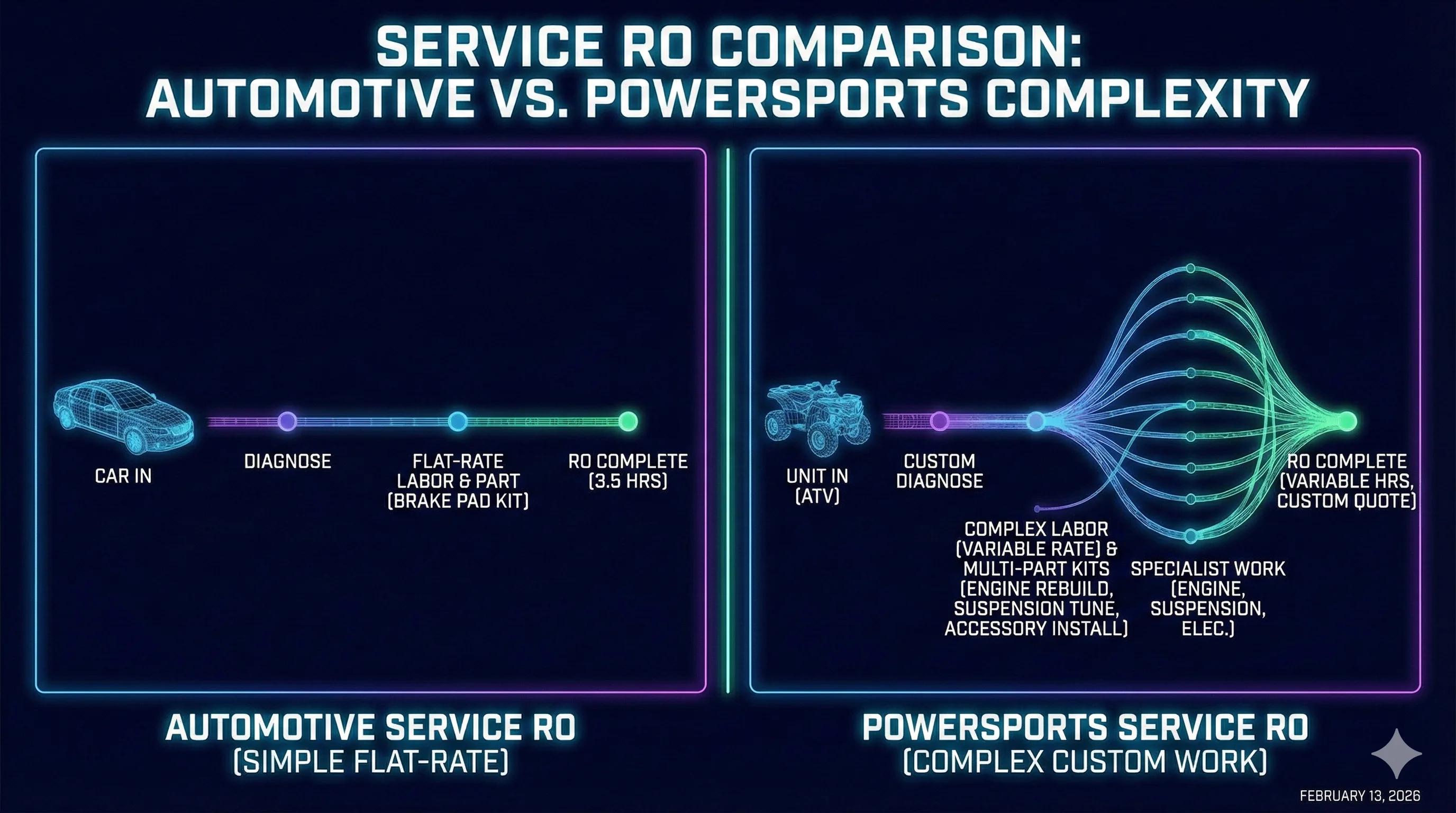
The Service Nuance: Flat-Rates for a Winch Install vs. a 30,000-Mile Oil Change
Service department operations reveal another fundamental mismatch between automotive and powersports business models that generic software cannot bridge.
The Automotive Flat-Rate Model
Automotive service operations run on standardized flat-rate labor times:
- Oil change: 0.3 hours
- Brake pad replacement: 1.2 hours
- Timing belt service: 3.5 hours
These times are universal, published by manufacturers, and predictable. A 2024 Honda Civic oil change takes the same time in Maine as it does in Arizona. The standardization allows automotive DMS to manage service scheduling, technician efficiency, and pricing with simple flat-rate lookup tables.
The Powersports Service Reality
Powersports service defies standardization:
Accessory installation labor: A winch installation on an ATV might take:
- 2.0 hours for basic mounting (no wiring complications)
- 4.5 hours if running custom wiring harness
- 6.0 hours if integrating with existing electrical accessories
- "It depends" is the only accurate answer
Condition-dependent service: Pre-season service on a stored motorcycle might involve:
- 0.8 hours if properly winterized, clean, no issues
- 3.5 hours if mice built nests in airbox and wiring needs repair
- Can't predict until the unit is on the lift
Customization and modification: Performance upgrades, custom exhaust systems, suspension modifications—these are common in powersports and defy flat-rate labor guides entirely
The Flat-Rate Impossibility: You cannot assign a flat-rate labor time to "install custom exhaust and tune carburetion for aftermarket performance intake on 2018 Yamaha YZ450F." The work is non-standard, involves troubleshooting, requires dyno tuning, and depends on which specific parts the customer selected. Yet this type of work represents 30-40% of service revenue at performance-oriented powersports dealerships.
The Parts vs. Labor Revenue Mix
Automotive service: Labor-heavy, parts-light A brake job is 70% labor revenue, 30% parts revenue The labor is standardized and predictable
Powersports service: Variable mix depending on job type
- Routine maintenance: 60% labor, 40% parts (similar to automotive)
- Accessory installation: 30% labor, 70% parts (parts-heavy)
- Performance modifications: 40% labor, 60% parts (parts-heavy with high margins)
- Repair work: Highly variable based on damage extent
This variable mix requires flexible service pricing, accurate parts margin tracking, and sophisticated commission structures—capabilities automotive DMS lacks.
Seasonal Service Patterns
Automotive service is relatively consistent year-round. Powersports service is extremely seasonal:
- Spring: Pre-season preparation, de-winterization, high volume routine service
- Summer: Repair work, accessory installation, moderate volume
- Fall: Winterization, pre-winter storage prep, moderate volume
- Winter: Low volume except snowmobile service in snow-belt markets
Automotive DMS assumes consistent service capacity utilization. Powersports DMS must handle:
- Seasonal appointment booking patterns (spring scheduling 6-8 weeks out)
- Seasonal technician hiring (bringing on extra help for spring rush)
- Seasonal parts stocking (massive spring parts inventory, minimal winter)
- Storage service tracking (tracking 200+ units in winter storage)
Winter Storage Revenue: Powersports dealers offer paid winter storage (motorcycle storage, boat storage, etc.) generating $200-500 per unit per season. This revenue stream doesn't exist in automotive and requires tracking storage location, pickup schedules, insurance liability, and de-winterization appointments. Automotive DMS has no concept of multi-month storage service revenue.
Technician Efficiency Metrics
Automotive DMS tracks technician efficiency as billable hours vs. actual hours—straightforward when all work is flat-rate.
Powersports technician efficiency is more complex:
- Flat-rate jobs (oil changes, routine maintenance)
- Estimate-based jobs (custom work quoted upfront)
- Time-and-materials jobs (repair work where scope unknown until disassembly)
- Warranty work (manufacturer-dictated labor times that don't match reality)
Tracking service department KPIs requires systems that handle this complexity. Automotive DMS treats non-flat-rate work as exceptions. Powersports DMS treats mixed labor types as standard operating procedure.
Key Insight: If your service advisors frequently override or ignore labor times suggested by the DMS, that's a signal the system doesn't understand your business. Proper powersports software allows flexible labor time management rather than forcing everything into automotive-style flat-rate rigidity.
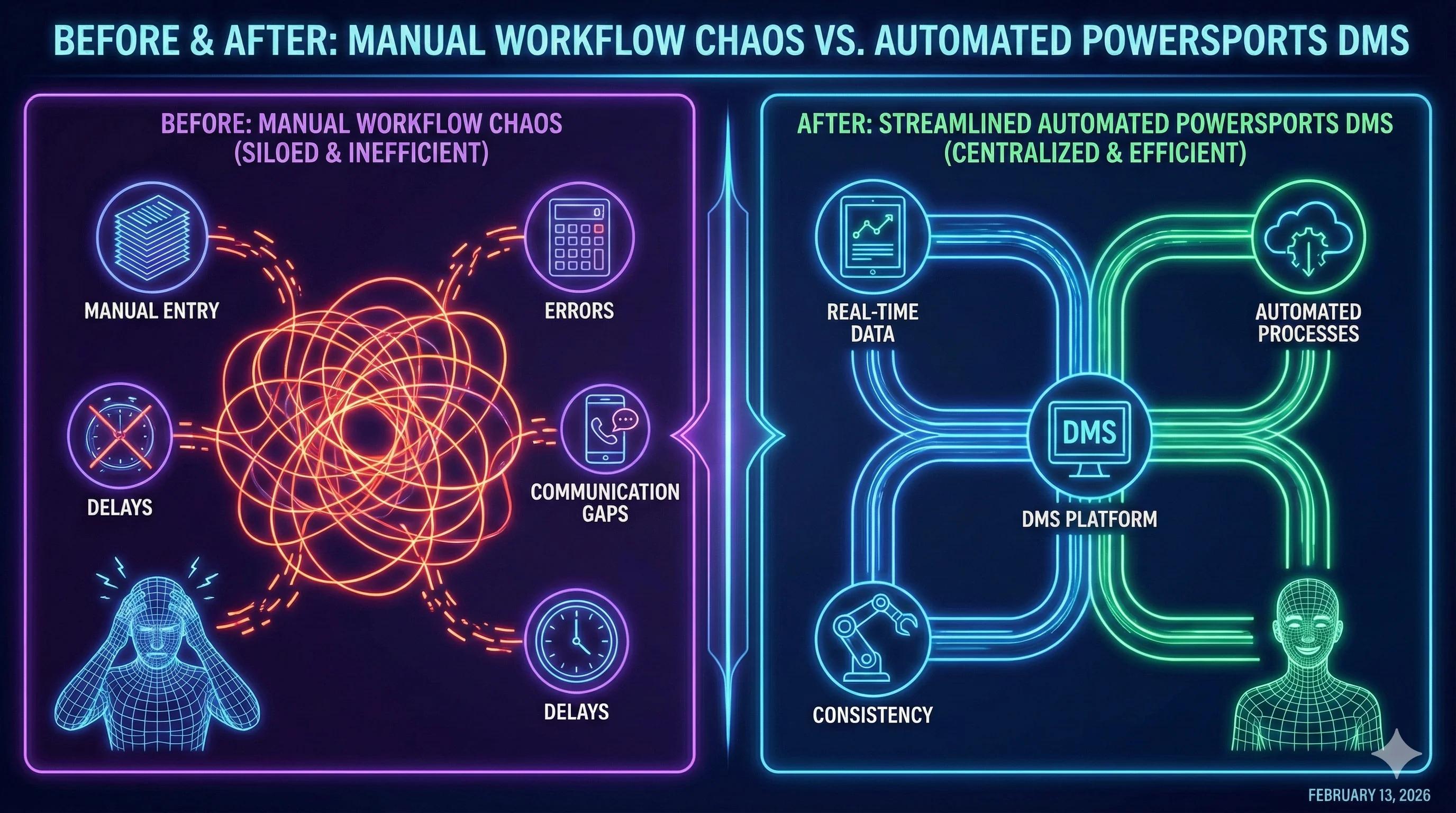
The Cost of "Workarounds" in a Generic System
The cumulative cost of using inappropriate software far exceeds the difference in licensing fees between automotive and powersports-specific DMS platforms.
Quantifying the Workaround Tax
Real cost analysis from mid-sized powersports dealer (150 units/month, 8-person staff) using automotive DMS:
| Inefficiency Source | Time Cost (Monthly) | Financial Impact (Annual) |
|---|---|---|
| Manual parts lookup delays | 90 hours | $54,000 lost billable time |
| Commission calculations | 40 hours | $28,800 admin labor |
| Floor plan management errors | N/A | $102,000 delayed curtailments |
| Parts obsolescence (excess) | N/A | $40,000 dead inventory |
| Manual price book updates | 12 hours (partial) | $8,600 admin labor |
| Missed manufacturer incentives | N/A | $18,000 unclaimed programs |
| Inventory discrepancies/errors | 15 hours | $12,000 reconciliation labor |
| Duplicate data entry | 25 hours | $18,000 admin labor |
| Total Annual Cost | 182 hours/month | $281,400 |
The $280K Question: This dealership is spending $281,400 annually on workarounds, inefficiency, and lost opportunities—all to avoid the $15,000-25,000 annual cost of specialized powersports DMS. That's a 11:1 negative ROI on the "cost savings" from using inappropriate software.
The Employee Turnover Cost
Beyond quantifiable operational costs, inappropriate tools drive employee turnover:
Service advisors: Trained advisors leave for dealerships with proper systems where they can be productive rather than fighting software Parts counter staff: Experienced parts personnel leave when forced to manually search catalogs instead of using integrated lookup Office staff: Administrative employees burned out from maintaining parallel spreadsheet systems
Conservative estimate: One additional employee turnover per year attributable to poor systems Replacement cost (recruiting, training, lost productivity): $25,000-35,000 Over 5 years: $125,000-175,000 in avoidable turnover costs
The Opportunity Cost
The most expensive cost is invisible: missed revenue from reduced efficiency.
If manual parts lookup and inefficient service workflows reduce service department capacity by 15%, a dealership generating $1.2M in annual service revenue is losing $180,000 in potential revenue annually—forever—because they're operating below capacity due to software limitations.
Pro Tip: Calculate your "software opportunity cost" by estimating capacity reduction from inefficiency. If your service department runs at 65% utilization instead of 80% due to software friction, multiply the 15% gap by annual service revenue. That's your annual opportunity cost—money you could generate with the same staff and facility if software removed the friction.
Case Study: The Conversion from Auto to Powersports DMS
Real-world example demonstrating the financial impact of switching from automotive to specialized powersports DMS.
Dealership profile: Multi-line powersports dealer, 5 brands (Yamaha, Polaris, Honda, Kawasaki, Can-Am), $8.5M annual revenue, 12 staff
The situation (2023-2024): Operating on automotive DMS for 8 years, with extensive workarounds and parallel Excel systems
Key problems identified:
- Parts lookup averaging 9 minutes per search
- Manual commission calculations taking 2-3 days post-month-end
- Inventory discrepancies requiring monthly full physical counts
- Service scheduling conflicts due to poor seasonal capacity management
- $67,000 in obsolete parts inventory (16% obsolescence rate)
- Missed manufacturer incentive programs (estimated $15-20K annually)
The decision: Switched to specialized powersports DMS (implementation cost: $28,000 including data migration, training, first-year licensing)
Results after 12 months:
| Metric | Before (Auto DMS) | After (Powersports DMS) | Impact |
|---|---|---|---|
| Parts lookup time | 9 minutes avg | 52 seconds avg | 90% reduction |
| Service revenue | $1.18M | $1.52M | +29% growth |
| Parts obsolescence | 16% ($67K) | 5% ($21K) | $46K recovered |
| Floor plan interest | $142K annual | $98K annual | $44K saved |
| Admin hours (monthly) | 215 hours | 87 hours | 128 hours freed |
| Inventory accuracy | 92% (monthly counts) | 99% (no manual counts) | +7% accuracy |
| Claimed mfr incentives | $22K (partial) | $51K (tracked) | +$29K found money |
Financial summary:
- Implementation cost: $28,000 (one-time)
- First-year benefits: $340,000+ (service growth + reduced obsolescence + floor plan savings + found incentives)
- ROI: 12:1 in first year
- Payback period: 31 days
The Owner's Perspective: "We wasted eight years trying to make automotive software work for our powersports business. We thought we were saving money. We were burning money. The switch paid for itself in a month, and a year later we're wondering why we waited so long. The efficiency gains alone are staggering—we're doing 25% more volume with the same staff because they're not fighting the software anymore."
Staff feedback (6-month post-implementation survey):
- 11/12 employees rated new system "significantly better" than previous
- Service advisors reported 40% reduction in customer wait time for quotes
- Parts counter staff rated integrated lookup as "game-changing"
- Office manager eliminated three weekly manual reports that automated in new system
Unexpected benefits:
- Better customer experience (faster service, accurate quotes, fewer errors)
- Improved manufacturer relationships (automated warranty claims, incentive tracking)
- Staff morale improvement (employees felt valued with proper tools)
- Competitive advantage (faster service turnaround than competitors)
Conclusion: Specialized Software Isn't Luxury—It's Operational Necessity
The automotive vs. powersports DMS question isn't about features and preferences—it's about fundamental business viability. Powersports retail operates under different constraints than automotive: multi-unit transactions, complex parts management across dozens of manufacturers, variable service work, aggressive supersession cycles, and seasonal operational patterns. These aren't edge cases that automotive DMS can accommodate with workarounds—they're core business requirements that define powersports operations.
The financial analysis is unambiguous: dealers using automotive software for powersports operations lose $200,000-300,000 annually through inefficiency, obsolescence, missed opportunities, and capacity limitations. The "savings" from avoiding specialized software costs 10-15x more than the software itself.
But the cost isn't just financial. Employee frustration from inadequate tools drives turnover. Customer experience suffers from slow service and pricing errors. Competitive position erodes as more efficient dealers capture market share. The cumulative effect compounds: wrong tools → frustrated staff → poor customer experience → lost business → declining profitability → inability to invest in proper systems → deeper hole.
Modern powersports dealer management software solves these problems not through generic workflow flexibility, but through purpose-built architecture designed for powersports operations. Automated OEM integration, sophisticated parts management, multi-unit transaction handling, and flexible service workflows aren't add-ons—they're the foundation.
The decision isn't whether you can afford specialized powersports DMS. The question is whether you can afford to keep operating without it.
Frequently Asked Questions (FAQs)
Can't we just customize our automotive DMS to handle powersports operations?
Customization seems logical but fails in practice. The architectural mismatch is too fundamental—automotive DMS is built around VIN-centric single-vehicle transactions. "Customizing" it for powersports means fighting the core architecture at every turn. Even with extensive custom development (often costing $50,000-100,000+), you end up with a fragile system requiring ongoing maintenance, breaking with every DMS update, and still lacking proper OEM integrations. Purpose-built powersports software costs less, works better, and doesn't break when the vendor releases updates.
We're a small dealer (50-75 units/year). Do we really need specialized software?
Small dealers actually benefit more from efficiency because they can't absorb inefficiency through scale. A 50-unit dealer losing 15% capacity to software friction loses 7-8 unit sales annually—directly impacting profitability. Small dealers also can't afford dedicated staff for workarounds. When your parts manager is also your service advisor and your office manager, wasting their time on manual processes that should be automated is especially costly. Specialized powersports DMS levels the playing field, giving small dealers enterprise-grade capabilities at accessible pricing.
What if we only sell one brand? Wouldn't automotive DMS work for single-brand powersports?
Single-brand dealers still face the multi-unit transaction problem (primary unit + trailer + accessories + gear), parts complexity (even a single-brand dealer carries 15,000-25,000 parts SKUs), service work variability, and seasonal patterns that automotive DMS can't handle. You might eliminate the multi-OEM integration complexity, but the fundamental architectural mismatches remain. Single-brand powersports dealers using automotive DMS report the same frustrations as multi-brand dealers—just with slightly fewer manufacturers involved.
How long does conversion from automotive to powersports DMS typically take?
Implementation timelines vary based on data quality and dealership size, but typical range is 6-12 weeks from decision to go-live. This includes data migration (inventory, customer records, open ROs, accounting data), staff training, and parallel operation period. The pain point isn't the implementation timeline—it's making the decision. Dealers who switch consistently report wishing they'd done it years earlier. The ROI is typically positive within 30-90 days.
Will we lose historical data if we switch from automotive DMS?
Reputable powersports DMS vendors provide data migration services that preserve historical transactions, customer records, and critical business data. You may not migrate every detail (some data won't translate between systems), but essential records transfer. Most dealers keep read-only access to old automotive DMS for historical reference while operating on new powersports system going forward. The historical data "loss" fear keeps dealers trapped in inappropriate systems longer than justified—in reality, migration preserves what matters.
How does DealerClick address the automotive vs. powersports DMS gap?
DealerClick's powersports dealer software was built from the ground up for powersports operations—not adapted from automotive systems. The platform natively handles multi-unit transactions, integrates with 8+ major powersports OEMs for automated price updates and parts supersession, manages complex parts inventory with year/make/model fitment, supports seasonal service patterns, and handles multi-lender floor plan management. Rather than forcing powersports workflows into automotive architecture, DealerClick designed the architecture around how powersports dealerships actually operate—eliminating workarounds and delivering single-system efficiency.
Stay Updated
Get the latest auto dealer insights delivered straight to your inbox.
No spam. Unsubscribe anytime.