The Unit Intake Playbook: VIN Decoding, Recon, and Web-Ready in 48 Hours
In 2026, if a unit isn't online within 48 hours of hitting the lot, you're losing money. This playbook streamlines the intake process from VIN decode to web listing.
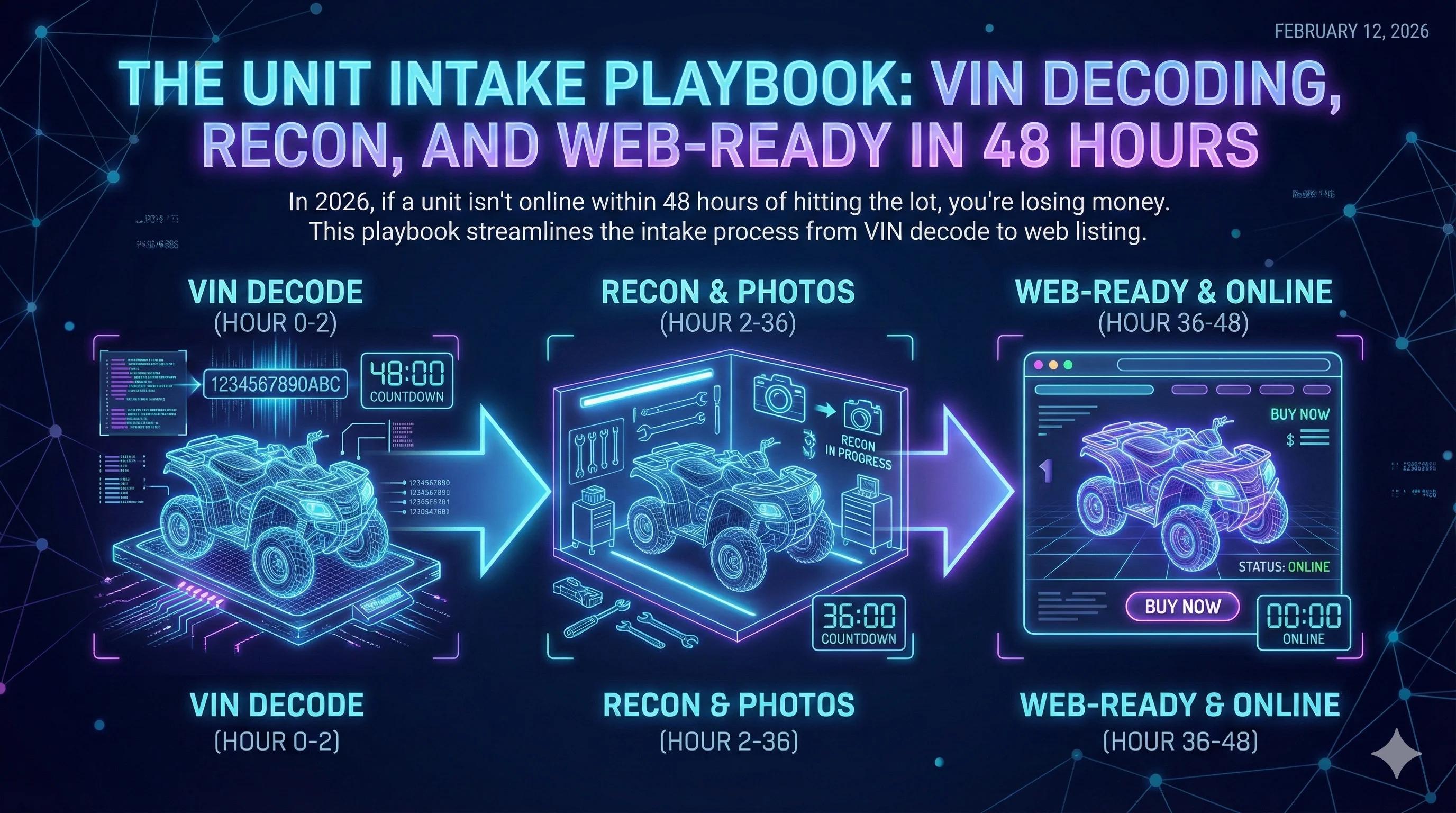
Every day a powersports unit sits "in process" between acquisition and online listing represents real money lost—floor plan interest accumulating, market depreciation accelerating, and competitors selling comparable units first. In 2026's hyper-competitive powersports market, the dealerships winning the inventory velocity game have mastered the 48-hour intake challenge: getting units from the lot to web-ready in two days or less.
Modern powersports dealer management software makes this velocity possible by eliminating manual data entry, automating reconditioning workflows, and connecting intake directly to online merchandising. This playbook details the exact four-step process leading dealers use to achieve 48-hour intake cycles, reduce carrying costs, and maximize inventory turn rates.
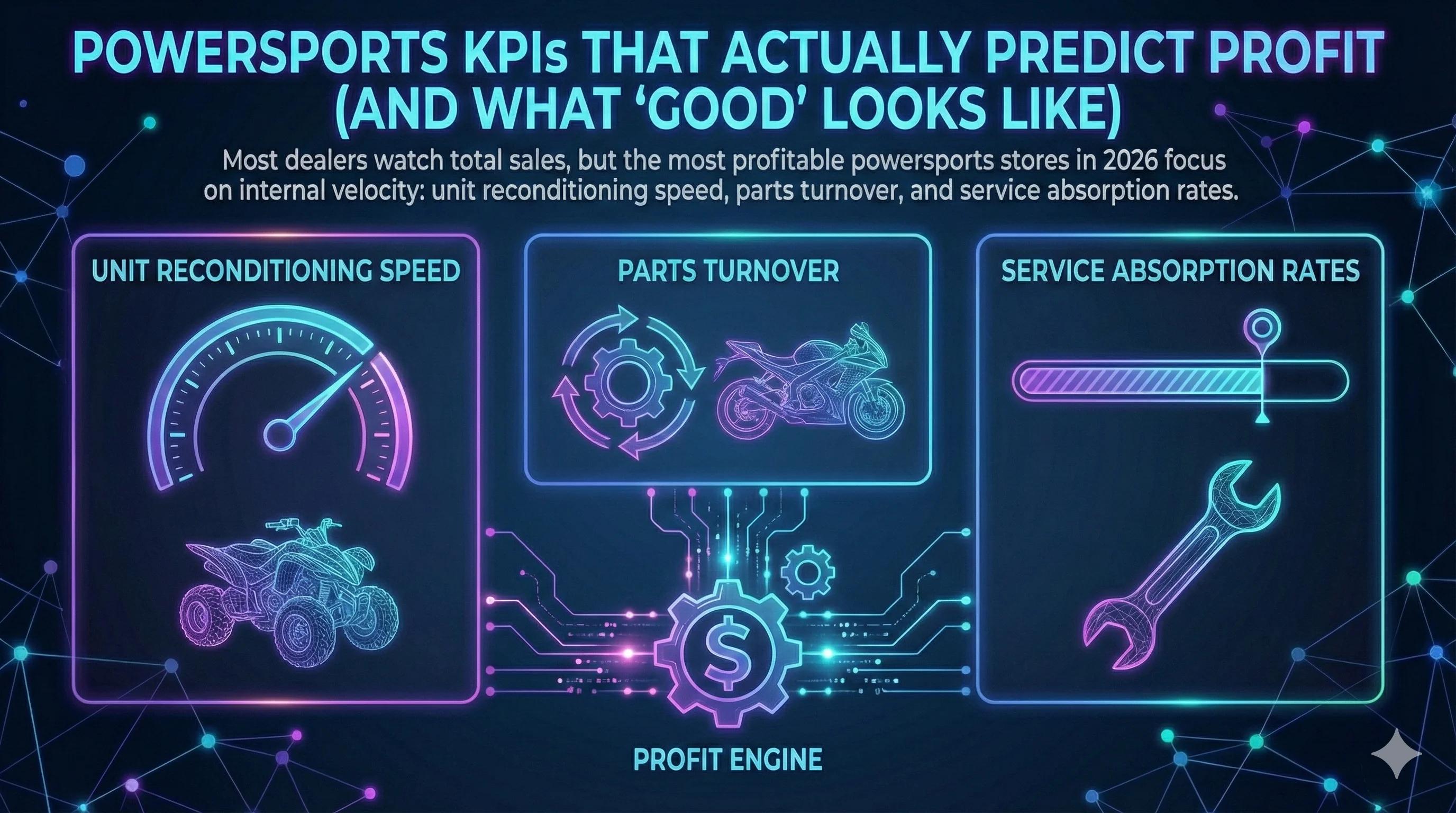
📈 Related Reading: Want to track whether your intake improvements are driving profitability? Read our guide on Powersports KPIs That Actually Predict Profit to learn which metrics matter most, including days-to-line and inventory turn rates.
The Hidden Cost of "Lot Rot": Why Slow Intake Kills Gross Profit
Before diving into the solution, it's critical to understand exactly what slow intake costs your dealership. "Lot rot"—the phenomenon of units sitting idle during intake and reconditioning—has quantifiable financial impact that compounds daily.
Direct Carrying Costs
Floor plan interest starts accruing the moment you acquire a unit. At typical floor plan rates of 7-9% annually, a $15,000 ATV costs approximately $3-4 per day in interest expense. For a dealer moving 50 units monthly with an average 14-day intake cycle, that's $2,100-2,800 monthly in unnecessary floor plan costs. Cut that cycle to 3 days, and you save $1,600-2,100 per month—nearly $20,000 annually.
Market depreciation doesn't wait for you to finish intake. Powersports units, particularly seasonal products, depreciate from the moment you acquire them. Marine units lose value as boating season progresses. ATVs depreciate as riding season passes. Every day spent in intake is a day of depreciation without the opportunity for sale.
Insurance and lot costs continue whether the unit is sale-ready or not. Facility expenses, security, and lot insurance accumulate regardless of listing status.
Opportunity Costs: The Hidden Killer
Beyond direct costs, slow intake creates massive opportunity costs that most dealers underestimate:
Lost first-mover advantage: In competitive markets, buyers shopping online see units from multiple dealers simultaneously. The first dealer to list a desirable unit at competitive pricing typically wins the sale. Your 14-day intake cycle means competitors with 3-day cycles list comparable units 11 days earlier—and often close the deal before you're even online.
Reduced selling season: For seasonal products, every day matters. A marine unit acquired April 1st but not listed until April 15th has lost two weeks of prime selling season. That's 15% of peak season visibility gone before your listing even goes live.
Capital trapped in process: Units stuck in intake represent capital you can't deploy elsewhere. That same $15,000 could be acquiring another unit if the first moved through intake faster, effectively doubling your inventory turn potential.
The Compounding Effect
These costs compound across your entire inventory.
💰 Real-World Financial Impact
Dealership Profile:
- 30 units in various intake stages
- Average 12-day intake cycle
- Average unit value: $12,000
- 8% floor plan rate
Current cost: $950/month in unnecessary floor plan interest = $11,400 annually
If you cut intake cycle to 4 days:
- Savings: $750/month = $9,000/year
Bonus benefit: Capital freed 8 days earlier on each unit = opportunity to acquire and sell more inventory with the same working capital
At scale, this becomes the difference between profitability and struggle.
The financial case for intake velocity is clear. Now let's examine how leading dealers achieve 48-hour cycles.
"Every day a unit sits in our intake queue is a day we're paying floor plan interest while a competitor is selling that same unit online. Once we cut our intake cycle from 10 days to 3 days, we saved $18,000 annually in floor plan costs alone—and that doesn't count the faster turns and competitive advantage." — Powersports Dealer Principal, Multi-Location Operation
Step 1: Mobile VIN Decoding — Pull OEM Specs in Seconds
The traditional intake process starts with someone manually researching unit specifications, typing them into the DMS, and hoping they got everything right. This manual approach is slow, error-prone, and entirely unnecessary in 2026.
How Mobile VIN Decoding Works
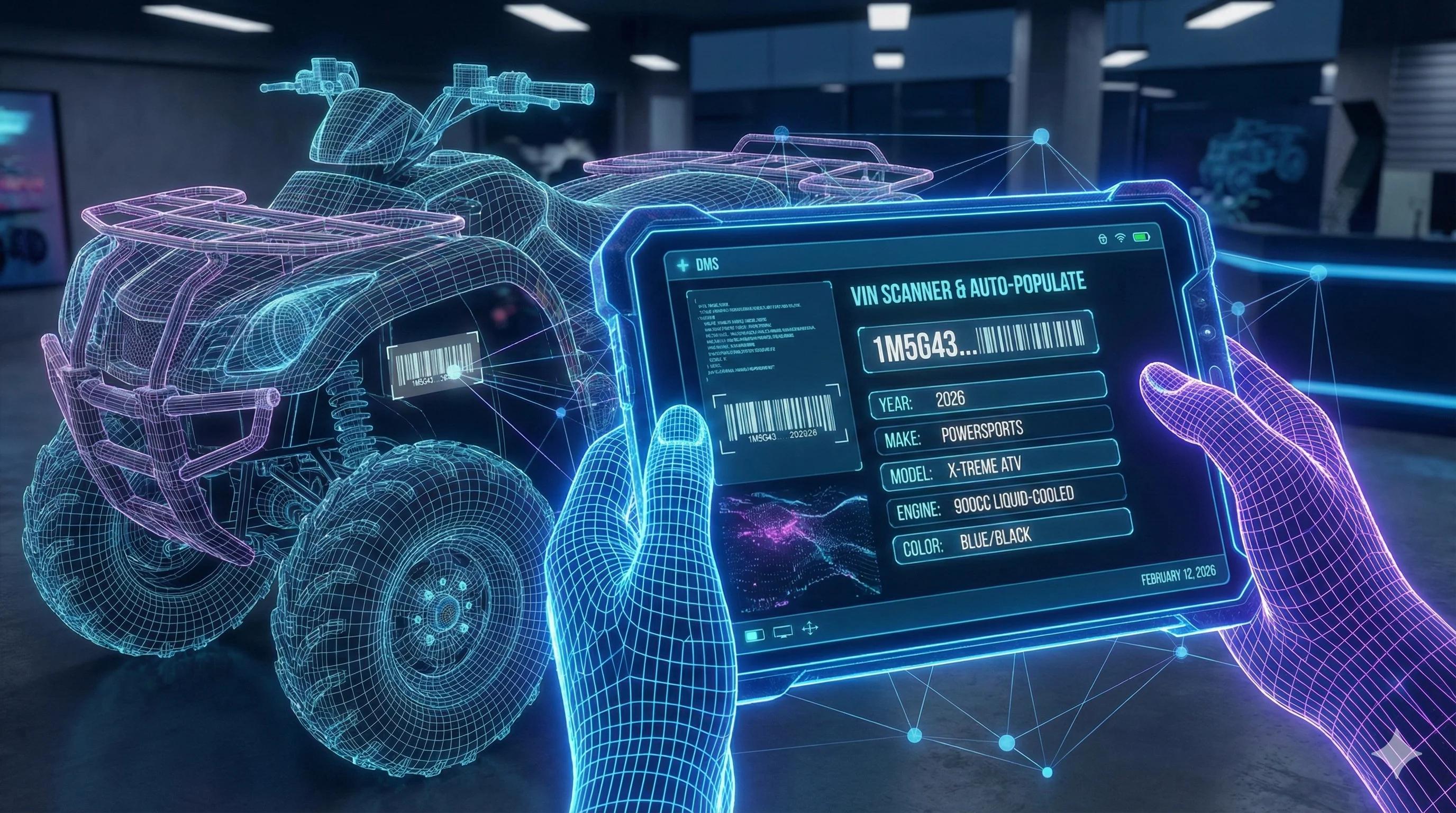
Modern powersports DMS platforms include mobile apps that allow sales managers, lot managers, or acquisition specialists to decode VINs instantly using a tablet or smartphone:
- Scan or enter the VIN using the device camera or keyboard
- Automatic OEM lookup queries manufacturer databases to retrieve complete specifications
- Data population automatically fills all DMS fields with accurate information
- Photo capture initiation triggers the merchandising workflow in one step
This entire process takes 60-90 seconds per unit versus 15-30 minutes of manual data entry.
What Gets Populated Automatically
Quality VIN decoding pulls comprehensive manufacturer data:
- Year, make, model, and trim level
- Engine size and type
- Standard equipment and features
- Original MSRP and model codes
- OEM color codes
- Weight and dimension specifications
- Recommended maintenance schedules
For used units, the system can also query service history databases (where available) to identify any open recalls or documented maintenance.
Avoiding Common VIN Decode Pitfalls
Not all VIN decoding is equal. Ensure your DMS partner provides:
Multi-OEM database access: Powersports VIN structures vary by manufacturer. Your system must support Polaris, BRP, Yamaha, Honda, Kawasaki, Suzuki, and marine manufacturers like Mercury and Yamaha.
Accessory and aftermarket recognition: Many powersports units include factory-installed accessories that don't appear in base VIN data. Systems should allow easy addition of these features during initial decode.
Historical data retention: For trade-ins you've previously serviced, the DMS should recognize the VIN and pull existing customer and service history automatically, providing valuable information for reconditioning decisions.
The bottom line: If your intake process still involves manually typing specifications from model guides or Google searches, you're wasting 20+ minutes per unit and introducing errors that create downstream problems.
Pro Tip: Test your VIN decode accuracy by running 10 random units through the system and manually verifying the populated data against OEM spec sheets. If you're seeing errors on more than 1 in 10 units, your VIN database provider isn't comprehensive enough for multi-brand powersports operations.
💡 Time Savings Snapshot
Manual specification entry: 15-30 minutes per unit
Mobile VIN decode: 60-90 seconds per unit
Time saved: ~25 minutes = More units processed, fewer errors
Step 2: The Digital Recon Order — Auto-Generate Service Tickets
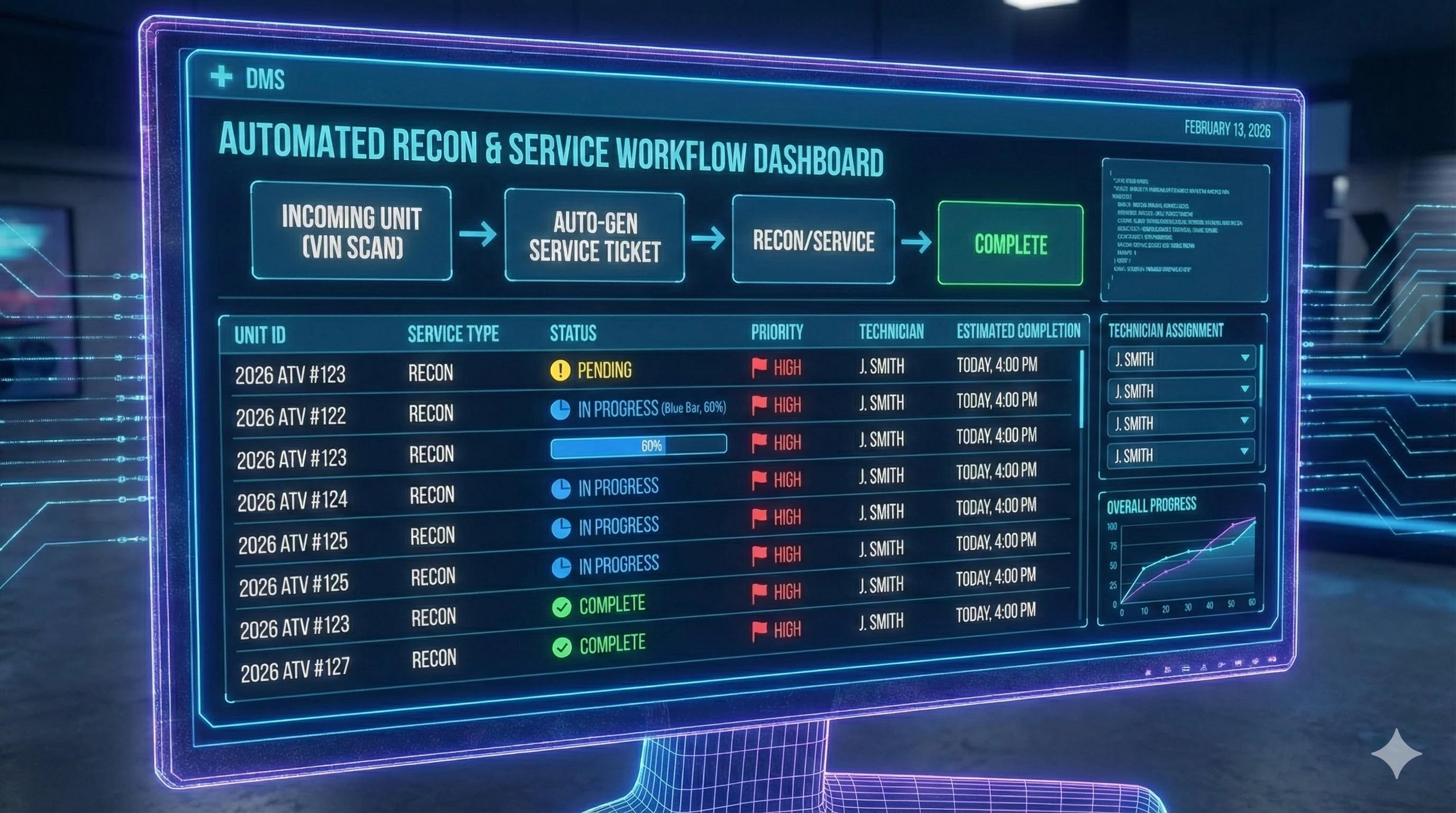
The moment you decode a VIN, your DMS should automatically evaluate whether reconditioning is needed and generate appropriate service orders. This digital workflow eliminates the "intake black hole" where units sit waiting for someone to remember they need service.
Intelligent Recon Workflow Automation
Leading DMS platforms use business rules to automatically determine reconditioning needs:
New units from floor plan: Typically require minimal recon—pre-delivery inspection (PDI), fluid level checks, accessory installation if ordered. The system generates a standard PDI checklist and assigns it to the service department.
Trade-ins and used acquisitions: Require detailed inspection and potentially significant reconditioning. The system generates:
- Multi-point inspection order
- Cleaning and detailing order
- Any manufacturer-recommended services based on mileage/hours
- Safety inspection where legally required
High-value or specialty units: May trigger additional photography for condition documentation or dealer principal approval before committing recon budget.
Service Department Integration
The power of digital recon orders is immediate service department visibility:
Automatic work order creation: The service manager sees new recon orders appear in the queue without anyone walking paperwork to the shop or making phone calls.
Priority flagging: Recon work orders can be automatically flagged as priority to ensure intake units don't sit behind retail customer work.
Parts allocation: If recon requires specific parts (tires, batteries, filters), the system can automatically check parts inventory and flag needed orders.
Technician assignment: Smart scheduling systems can automatically assign recon work based on technician availability and specialization.
Recon Budget Controls
Automated recon workflows should include budget management:
Per-unit recon budgets: Based on acquisition price and target margin, set maximum recon spend. If inspection reveals needs exceeding budget, the system flags for manager review.
Approval workflows: Major recon items (engine work, transmission service, significant cosmetic repair) can require manager approval before proceeding, preventing budget overruns.
Real-time cost tracking: As parts and labor are added to the recon order, the system tracks actual spend against budget, providing early warning if costs are trending over target.
The goal is eliminating the manual coordination that traditionally adds days to intake. When a unit arrives, recon orders should be in the service queue within minutes, not waiting for someone to "get around to it."
Service Manager Insight: "The difference between manual and automated recon workflows isn't just speed—it's accountability. With automated work orders, nothing falls through the cracks. Every unit has a digital trail showing exactly where it is in the process. Before automation, we'd occasionally find units that sat for weeks because someone forgot to create the paperwork."
⚡ Digital Recon Impact
Traditional Process:
- Intake → paperwork → someone walks it to service → manager reviews → gets scheduled
- Timeline: 2-5 days before recon starts
Automated Workflow:
- Intake → instant work order in service queue → auto-assigned to technician
- Timeline: Recon starts same day or next morning
Days saved: 1-4 days per unit
Step 3: High-Velocity Merchandising — Website-Ready in One Click
Once reconditioning is complete (or for new units requiring only PDI), the final barrier to online listing is photography and description creation. This is where many dealerships still lose days in the intake process—waiting for photos, manually uploading them, writing descriptions, and finally publishing listings.
Integrated Photo Workflow
Modern powersports DMS platforms integrate with mobile photography apps that streamline the entire merchandising process:
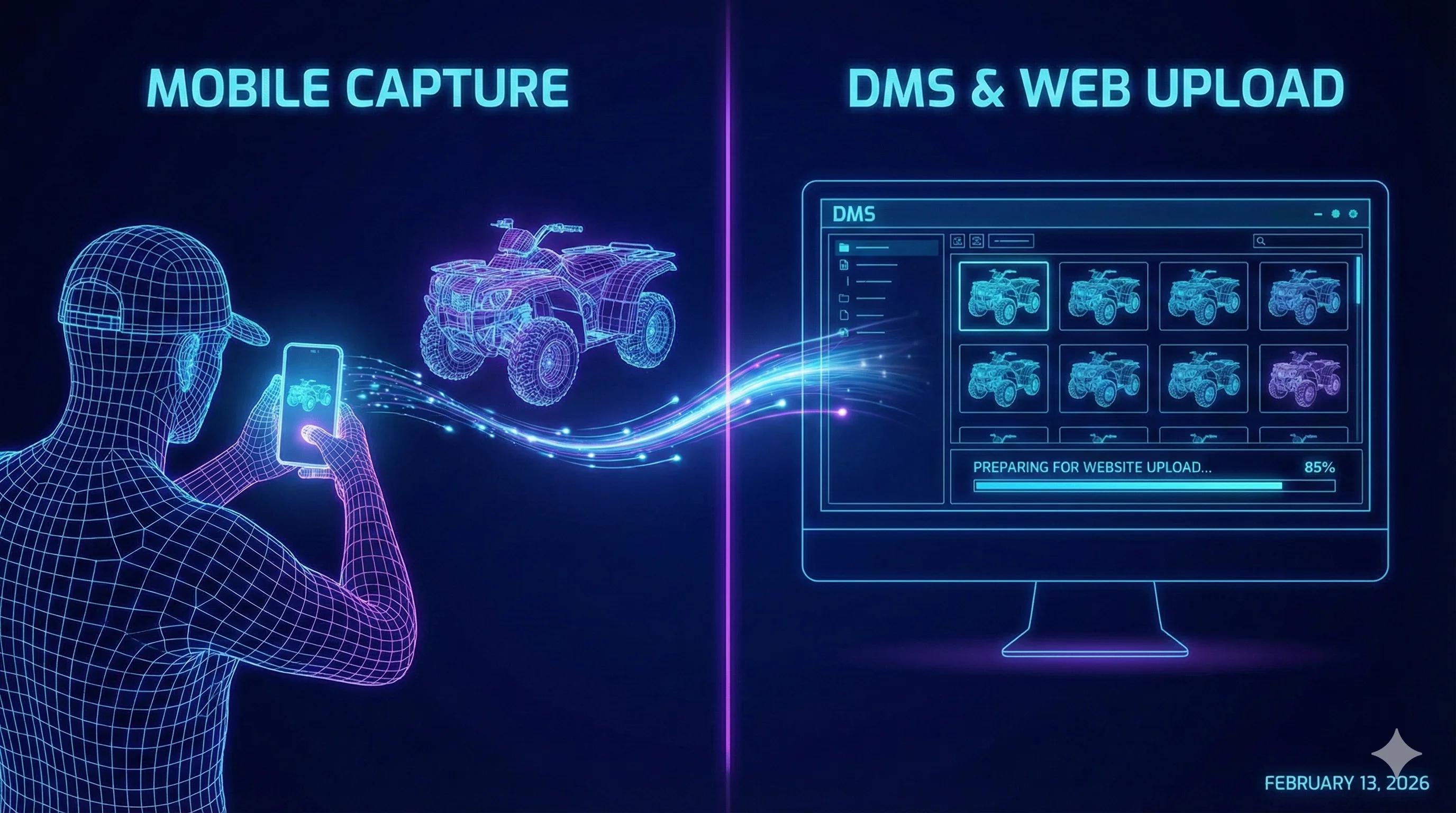
Photo capture with automatic unit association: Staff use tablets or smartphones to photograph the unit. Because they scanned the VIN during initial intake, the app knows which unit is being photographed and automatically associates images with the correct inventory record.
Template-based photo sequences: The app guides photographers through a standardized sequence (front three-quarter, rear three-quarter, side profile, engine close-up, control panel, accessory detail, odometer/hour meter reading). This ensures consistency and completeness.
On-device editing: Basic cropping, brightness adjustment, and background enhancement happen on the device, eliminating the need to upload raw photos and edit them later on desktop software.
Automatic upload and sync: Approved photos sync directly to the DMS and simultaneously to your website and third-party listing sites (Cycle Trader, ATV Trader, etc.). No manual upload to multiple platforms.
AI-Assisted Description Generation
The most advanced systems in 2026 use AI to assist with listing description creation:
Template population: Based on VIN-decoded specifications and photographed features, the system generates a comprehensive description highlighting key selling points.
Keyword optimization: Descriptions automatically include relevant search terms buyers use (model nicknames, common applications, comparable models).
Compliance language: Required disclosures, warranty information, and dealership policies are automatically included based on jurisdiction and unit type.
Staff review and refine the AI-generated description rather than writing from scratch, cutting description time from 10-15 minutes to 2-3 minutes.
One-Click Multi-Channel Publishing
Here's where integrated systems truly shine: publishing to your website and third-party sites simultaneously.
Website auto-publish: The moment you mark a unit "ready for sale" in the DMS, it appears on your website with complete specifications, photos, and description. No separate website admin login required.
Third-party syndication: The same action publishes to Cycle Trader, ATV Trader, Boat Trader, or other platforms you're integrated with. Listings appear on all channels within minutes.
Social media promotion: Some systems can automatically generate social media posts announcing new inventory, pulling photos and key specs directly from the listing.
The entire process from "unit is clean and ready" to "live on website and listing sites" should take 15-20 minutes, not 2-3 days of back-and-forth with marketing staff or website administrators.
Pro Tip: Photo quality directly impacts selling speed. Invest in a simple smartphone gimbal stabilizer ($100-200) and LED lighting panels ($150) for your photo area. Professional-looking photos taken with a smartphone and proper lighting outperform poor photos from expensive cameras. Buyers shop on phones—your photos need to look great on small screens.
📸 Merchandising Time Savings
Old workflow: Photos → upload to computer → edit → upload to website admin → copy to Cycle Trader → write description → publish
- Time required: 45-90 minutes per unit
- Common delay: Waiting for marketing team availability
Integrated workflow: Capture on phone → auto-sync → AI description → one-click publish
- Time required: 15-20 minutes per unit
- Delay eliminated: No handoffs between departments
Result: Units go live same day recon completes, not 2-3 days later
Step 4: Dynamic Pricing — Market Intelligence for Competitive Advantage
The final element of rapid intake is pricing—and in 2026, powersports dealers who still price based purely on acquisition cost and gut feel are leaving money on the table. Dynamic pricing using market data integrations ensures units are priced competitively from day one.
Real-Time Market Data Integration
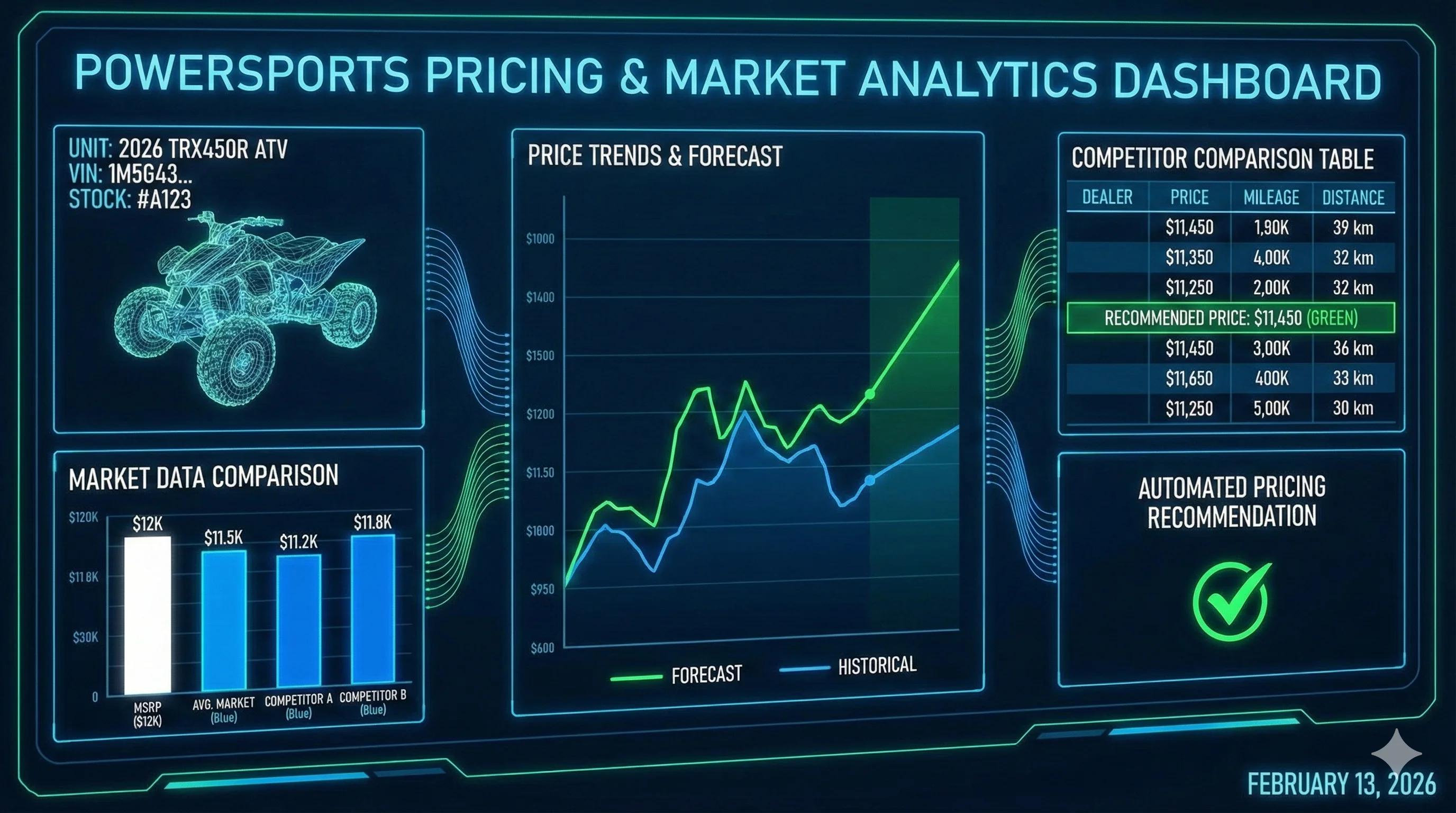
Leading DMS platforms integrate with market data providers that track actual selling prices, listing prices, and days-on-market for comparable powersports units:
Automated comparable search: Based on the VIN-decoded specifications, the system identifies similar units currently listed or recently sold in your market area.
Price positioning recommendations: The data shows where your intended asking price falls relative to competitive listings—are you priced 10% above market (expect slow turn), at market average (competitive), or 5% below (quick turn opportunity)?
Days-on-market correlation: Historical data reveals how pricing impacts selling time. Units priced in the top quartile for their category average 45+ days on market. Units priced in the second quartile average 28 days. Bottom quartile pricing (still profitable but aggressive) averages 12 days.
Strategic Pricing Rules
Smart dealers use their DMS to implement dynamic pricing strategies:
Seasonal adjustments: Marine units acquired in July (late season) are automatically flagged for aggressive pricing to move before season ends. ATVs acquired in March (early spring) can support premium pricing during peak demand.
Age-based price reductions: Set automatic price reductions based on days-on-market. A unit reaching 30 days might trigger a 3% price reduction. Reaching 60 days triggers another 5% reduction. This ensures aging inventory doesn't stagnate.
Margin protection: The system can enforce minimum margin requirements, preventing staff from pricing units below dealership profitability thresholds even when trying to move aged inventory.
Pricing Paradox: Dealers often fear aggressive pricing will "leave money on the table." But the data consistently shows that a unit priced to sell in 15 days at $12,500 generates higher net profit than the same unit priced at $13,500 taking 45 days to sell—when you factor in floor plan interest, opportunity cost, and depreciation. Velocity beats margin every time.
The Pricing-Velocity Balance
Understanding the relationship between price and velocity is critical:
📊 Pricing Strategy Comparison
Conservative Pricing (Market Average):
- Sells in: 30 days
- Gross profit: $1,800
- Floor plan interest (30 days): -$135
- Net profit: $1,665
Aggressive Pricing (8% Below Market):
- Sells in: 12 days
- Gross profit: $1,500
- Floor plan interest (12 days): -$54
- Net profit: $1,446
Analysis: "Aggressive" strategy generates $219 less per unit BUT frees capital 18 days faster. That freed capital can be deployed into another deal, compounding profitability through velocity rather than margin maximization.
The data-driven approach: Modern DMS platforms provide market intelligence to make these decisions strategically rather than guessing. You can model different pricing scenarios and see projected outcomes before setting your price.
The "48-Hour Challenge": A Manager's Checklist
Achieving 48-hour intake velocity requires operational discipline. Here's the exact checklist high-performing dealers use:
✅ The 48-Hour Standard
This checklist transforms intake from an ad-hoc, multi-week process into a standardized 48-hour system. Print this and post it in your intake area. Review completion rates weekly to identify bottlenecks.
Day 1 (Acquisition Day):
Hour 1: Intake and VIN Decode
- [ ] Unit arrives and is parked in designated intake area
- [ ] VIN scanned using mobile app
- [ ] OEM specifications auto-populate in DMS
- [ ] Initial condition photos captured
- [ ] Acquisition details recorded (trade-in, auction, private purchase)
Hour 2-4: Recon Order Generation and Service Prioritization
- [ ] DMS auto-generates recon work order based on unit type and condition
- [ ] Service manager reviews and confirms recon scope
- [ ] Recon budget confirmed (for used units)
- [ ] Work order assigned to available technician
- [ ] Any needed parts ordered immediately
Hour 4-8: Begin Reconditioning
- [ ] Unit moved to service bay
- [ ] Multi-point inspection completed
- [ ] Cleaning and detailing initiated
- [ ] Any mechanical issues identified and flagged
Day 2 (Next Business Day):
Hour 24-30: Complete Reconditioning
- [ ] All mechanical recon completed
- [ ] Cleaning and detailing finished
- [ ] Unit passes final inspection
- [ ] Unit moved to designated "photo ready" area
Hour 30-36: Photography and Merchandising
- [ ] Full photo sequence captured using mobile app
- [ ] Photos auto-sync to DMS and inventory systems
- [ ] AI-generated description reviewed and refined
- [ ] Accessories and upgrades documented
Hour 36-48: Pricing and Publication
- [ ] Market data reviewed for competitive pricing
- [ ] Asking price set based on margin target and market positioning
- [ ] Unit marked "ready for sale" in DMS
- [ ] Listing auto-publishes to website and third-party sites
- [ ] Social media announcement (optional)
Completion Verification:
- [ ] Unit visible on website with complete information
- [ ] Unit listed on relevant third-party sites
- [ ] Sales team notified of new inventory availability
Following this checklist transforms intake from an ad-hoc, multi-week process into a standardized 48-hour system.
Key Insight: The checklist isn't just for tracking—it's for accountability. When every unit has a timestamped trail showing exactly where it is in the 48-hour cycle, bottlenecks become visible immediately. If 80% of units are completing recon in 24 hours but photography consistently takes 6-8 hours, you know where to focus improvement efforts.
How the Right DMS Eliminates Manual Data Entry
The common thread throughout this playbook is automation—and automation only works when your DMS is purpose-built for powersports dealership workflows.
🔧 Essential DMS Capabilities for 48-Hour Intake:
✅ Mobile VIN decoding with OEM database integration
✅ Automated recon work order generation
✅ Mobile photo apps with direct DMS sync
✅ Market data integration for pricing intelligence
✅ One-click multi-channel publishing (website + listing sites)
✅ Real-time status visibility across all intake stages
If your current system lacks these capabilities, you're competing with one hand tied behind your back.
Here's what to expect from a quality system:
Connected Workflows, Not Disconnected Systems
Single data entry: VIN decode happens once. That data flows automatically to service orders, inventory listings, website content, and third-party syndication. No one types the same specifications multiple times.
Status visibility: Everyone knows where every unit is in the intake process. Service managers see what's awaiting recon. Sales managers see what's being photographed. Management sees overall intake velocity metrics.
Exception management: When something goes wrong (recon over budget, unit requires significant repair, pricing dispute), the system flags it for manager intervention rather than allowing units to sit unnoticed.
Mobile-First Design
Intake happens on the lot, in the service bay, and in the photography area—not at desktop computers. Your DMS must support tablet and smartphone workflows for:
- VIN decoding and initial intake
- Recon work order management
- Photo capture and upload
- Final inspection sign-off
If your staff need to return to desktop terminals to move units through intake stages, you're adding unnecessary friction and time.
Integration With Critical Systems
Your powersports DMS should integrate seamlessly with:
- Floor plan lenders: Automatic curtailment tracking and audit reporting
- Market data providers: Real-time pricing intelligence
- Photography and merchandising tools: Direct upload from capture apps
- Website and listing sites: One-click multi-channel publishing
- Parts inventory systems: Automated parts checking and ordering for recon
Disconnected systems require manual data transfer, creating the delays and errors that slow intake.
Reporting and Continuous Improvement
The only way to improve intake velocity is measuring it. Your DMS should provide:
Average days-to-line by unit type: Are ATVs moving faster than marine? Where should you focus improvement efforts?
Bottleneck identification: Do units spend 8 days awaiting recon but only 1 day in photography? The recon process needs attention.
Staff productivity tracking: Which acquisition specialists are fastest at intake? Which photographers complete merchandising most efficiently? Use this data for training.
Cost analysis: What's your average intake cost per unit (labor, recon, carrying costs)? How does this impact overall unit profitability?
Modern powersports dealer software from DealerClick provides all these capabilities out of the box, transforming intake from a multi-week bottleneck into a competitive advantage.
Conclusion: Velocity as a Competitive Moat
In 2026's transparent, online-driven powersports market, the dealerships that win aren't necessarily those with the biggest inventory or best locations—they're the ones that move fastest.
Intake velocity determines:
- How quickly you can respond to market opportunities (trending models, seasonal demand shifts)
- How much floor plan interest you pay (every day saved is money earned)
- Whether you capture first-mover advantage on desirable units
- How many times you can turn capital annually (velocity compounds profitability)
The 48-hour intake challenge isn't aspirational—it's achievable with the right DMS platform, standardized processes, and operational discipline.
"Before we streamlined our intake process, we thought 10-14 days was 'just how long it takes.' Now we're consistently under 3 days, and the difference is staggering. We're selling units faster, paying less floor plan interest, and our sales team has fresh inventory to sell constantly. The 48-hour goal seemed impossible until we actually implemented the right systems and processes—then it became routine." — Operations Manager, High-Volume Powersports Dealer
🎯 Proven Results from Dealers Implementing This Playbook:
✅ 60-70% reduction in average days-to-line
✅ $8,000-15,000 annual savings in floor plan interest
✅ 15-25% improvement in inventory turn rates
✅ Fewer errors and customer complaints related to listing inaccuracy
✅ Better staff morale — no more hunting for paperwork or chasing missing information
Most importantly, they report better staff morale. When intake is fast and automated, nobody's hunting for paperwork, chasing down missing information, or wondering why a unit acquired three weeks ago still isn't online.
If your current intake process regularly exceeds one week from acquisition to web-ready, you're leaving significant money on the table—and losing competitive battles to faster-moving rivals. The solution is clear: implement mobile VIN decoding, automated recon workflows, integrated merchandising, and dynamic pricing. Turn intake velocity into your competitive advantage.
Ready to achieve 48-hour intake cycles and maximize inventory velocity?
Frequently Asked Questions (FAQs)
How realistic is the 48-hour intake goal for smaller dealerships?
The 48-hour intake goal is highly achievable for dealerships of all sizes, often easier for smaller operations due to simpler coordination. The key is not dealership size but process automation. Small dealers using mobile VIN decoding, digital work orders, and integrated photography regularly achieve 2-3 day intake cycles. Larger dealers may face more coordination complexity but have more staff to parallelize tasks. The critical success factor is implementing the right DMS platform with automated workflows, not the number of units you move monthly.
What if we do significant reconditioning on used units that takes longer than 48 hours?
The 48-hour target applies to the intake and administrative process, not necessarily mechanical reconditioning. The goal is ensuring that within 48 hours of acquisition: (1) the unit is fully documented in your DMS with complete specifications, (2) recon work orders are created and in-process, (3) pricing strategy is determined, and (4) merchandising is ready to execute the moment recon completes. For units requiring extensive mechanical work, the listing can go live as "in reconditioning" or "coming soon" with estimated availability dates, capturing buyer interest while work continues.
Our current DMS doesn't support mobile VIN decoding. Are there third-party solutions?
While some third-party apps offer VIN decoding capabilities, they typically create additional manual work because data must be transferred from the app into your DMS manually—defeating the automation purpose. If your current DMS lacks native mobile VIN decoding, this is a strong signal to evaluate whether it's the right platform for 2026 powersports operations. Modern platforms like DealerClick include mobile VIN decoding as standard functionality, not an add-on, because it's fundamental to efficient intake workflows.
How do we handle unique or modified units where VIN data doesn't capture everything?
VIN decoding provides the factory baseline specifications, which you then supplement with unit-specific details (aftermarket accessories, custom modifications, condition notes). Quality DMS platforms make it easy to add these details during the intake process. The VIN decode handles 80% of data entry automatically; you manually add the remaining 20% that makes each unit unique. This is still dramatically faster than manually entering 100% of specifications from scratch, and more accurate because the base data comes directly from OEM databases.
What's the typical ROI timeline for investing in DMS automation to improve intake velocity?
Most dealers see positive ROI within 3-6 months through reduced floor plan interest expense alone. Calculate your current average days-to-line, multiply by your average daily floor plan interest per unit, and multiply by monthly unit acquisition volume. This shows your monthly unnecessary carrying cost. Modern DMS platforms that reduce intake time by even 5-7 days typically save $500-1,500 monthly for dealers moving 20-30 units. Add the additional revenue from selling units faster (capturing first-mover advantage) and improved inventory turn rates, and the ROI case becomes compelling quickly.
Does faster intake mean sacrificing reconditioning quality or accurate pricing?
No—in fact, the opposite is true. Automated intake workflows improve quality through standardization and checklists. Digital recon orders ensure nothing gets forgotten. Mobile apps guide photographers through complete photo sequences. Market data integration produces more accurate pricing than gut-feel decisions. Slow intake typically results from disorganization, missing information, and tasks falling through cracks—not from deliberate quality focus. Fast intake comes from removing friction and automating routine tasks, freeing staff to focus on the aspects that truly require human judgment and expertise.
Stay Updated
Get the latest auto dealer insights delivered straight to your inbox.
No spam. Unsubscribe anytime.