RTO Underwriting Beyond Credit Scores: Building a Resilient Portfolio
Traditional credit scores often fall short for Rent-to-Own (RTO) customers. Discover how to build a robust underwriting process focused on stability, capacity, and behavioral insights to create a resilient and profitable RTO portfolio.

In the Rent-to-Own (RTO) market, success hinges on a fundamental truth: traditional credit scores don't tell the whole story. For millions of credit-challenged consumers, a low FICO score reflects past financial hurdles, not necessarily a current inability or unwillingness to make payments. Relying solely on conventional metrics in this segment is a recipe for missed opportunities and an unhealthy portfolio. To understand the broader operational framework that RTO operates within, refer to our pillar post: "The Ultimate Guide to Launching and Scaling a Profitable Rent-to-Own Dealership". This guide specifically illuminates how to build a resilient RTO portfolio by adopting an underwriting approach that looks beyond traditional credit scores, focusing instead on key indicators of stability, capacity, and behavioral insights tailored for the RTO customer.
The Problem: Conventional Underwriting Fails the RTO Market
Applying traditional auto loan underwriting criteria to the RTO market creates a significant disconnect, leading to several critical problems:
- Excluding Deserving Customers: Many individuals with stable jobs, consistent income, and a genuine need for transportation are unfairly denied due to past credit blemishes, limiting your potential customer base.
- Misjudging Risk: A low FICO score doesn't always equate to high RTO risk. Dealers miss crucial non-credit indicators of payment stability, leading to poor decisions on who to approve or deny.
- Unhealthy Portfolio Mix: Without a nuanced approach, portfolios can become either too conservative (missing profitable opportunities) or too risky (experiencing high delinquency and charge-offs).
- Increased Operational Costs: Reactive collections become the norm when initial underwriting is flawed, leading to higher staffing needs, more repossessions, and reduced profitability.
- Missed Growth Opportunities: An inability to accurately assess RTO-specific risk hinders expansion and market penetration in a rapidly growing segment.
These challenges highlight the need for a specialized RTO underwriting methodology that accurately evaluates subprime customers.
The Solution: A Data-Driven, RTO-Specific Underwriting Framework
The solution lies in developing a tailored RTO underwriting framework that prioritizes current capacity and stability over historical credit mishaps. This data-driven approach involves identifying and weighting key non-credit indicators, developing a custom RTO scorecard, and integrating behavioral insights into the decision-making process. By focusing on a customer’s ability and willingness to pay today, rather than their past FICO score, RTO dealerships can build a more resilient and profitable portfolio. This specialized framework empowers dealers to serve a vital customer segment while mitigating risk, fostering customer loyalty, and ensuring sustainable business growth.
Key Benefits of RTO Underwriting Beyond Credit Scores
Adopting a specialized RTO underwriting approach yields significant benefits for your dealership:
- Expanded Customer Base: Access to a larger pool of underserved, yet deserving, customers.
- Improved Portfolio Performance: Higher payment success rates and lower delinquency through accurate risk assessment.
- Reduced Charge-Offs & Repossessions: Proactive identification of stable customers minimizes future losses.
- Increased Profitability: Optimized risk vs. reward decisions lead to a healthier bottom line.
- Enhanced Customer Loyalty: Approving customers who genuinely need and can afford a vehicle builds strong, lasting relationships.
- Competitive Advantage: Differentiate your dealership by offering flexible solutions beyond traditional finance.
- Sustainable Growth: A resilient portfolio provides a solid foundation for expansion and long-term success.
1. Introduction: Why RTO Underwriting Needs a Different Approach
Traditional auto lending relies heavily on credit bureau scores (like FICO) to assess risk. These scores are designed for prime and near-prime borrowers and often penalize minor, often unavoidable, financial missteps that have little bearing on a customer's current ability to make a weekly or bi-weekly payment. RTO customers, by definition, often fall outside these traditional boxes.
2. The Limitations of FICO for Subprime: Understanding the RTO Customer Profile
For many RTO applicants, a low FICO score isn't a reflection of irresponsibility, but rather a snapshot of past challenges—job loss, medical emergencies, divorce, or simply a lack of credit history.
- Past vs. Present: FICO is backward-looking. RTO underwriting needs to be forward-looking, assessing current stability.
- Thin Files: Many subprime customers have "thin" credit files, meaning insufficient data for traditional scoring to be accurate.
- Behavioral Nuances: The discipline required for weekly/bi-weekly payments in RTO is different from monthly loan payments, and traditional scores don't capture this.
Understanding this distinction is crucial. Your RTO customer is often working, has income, and needs reliable transportation, but is shut out by conventional lenders.
3. Key Underwriting Pillars for RTO: Beyond the Score
A robust RTO underwriting process builds on a foundation of "Five Cs": Character, Capacity, Capital, Collateral, and Conditions. For RTO, we emphasize Character and Capacity, redefining them with subprime in mind.
3.1 Income Stability: The Bedrock of Capacity
- Proof of Income: Require recent pay stubs (30-90 days), bank statements (90 days), and employer verification calls. Look for consistency, not just a high number.
- Diverse Income Sources: Account for gig economy income, benefits, and multiple part-time jobs. Document thoroughly.
- Income Verification Methods: Beyond phone calls, consider online verification services or physically visiting workplaces (with consent).
3.2 Residence Stability: A Proxy for Character and Reliability
- Duration at Current Address: Long-term residence often indicates stability.
- Landlord/Utility Checks: Verify residency and payment history with landlords or utility companies.
- Transportation Needs: Is the vehicle essential for them to get to a stable residence/job?
3.3 Job Stability: Predicting Future Payments
- Employment History: Look for consistent employment, even if jobs have changed. Gaps should be explained.
- Industry Analysis: Certain industries (e.g., healthcare, education) tend to be more stable than others.
- Proximity to Work: Is the vehicle essential for commuting?
3.4 References: Uncovering Character and Network
- Personal and Professional References: Require multiple verifiable references. Contact them to ask about reliability, payment habits, and character.
- Emergency Contacts: These are critical for collections and communication.
3.5 Debt-to-Income (DTI) and Payment-to-Income (PTI) Ratios: Realistic Affordability
- Calculate Accurately: Include all known monthly expenses (rent, utilities, existing debts) against verified net income.
- Realistic Expectations: The RTO payment should comfortably fit within their budget, allowing for other necessities. A PTI ratio of 10-15% is a common benchmark, but adjust based on risk and local cost of living.
3.6 Behavioral Data: Insights from Non-Credit Items
- Past Payment Habits: Ask about past payment history for rent, utilities, cell phone bills. Consistent payments here are strong indicators.
- Previous Auto Loans (Even if Subprime): Understand the circumstances around any previous defaults or repossessions.
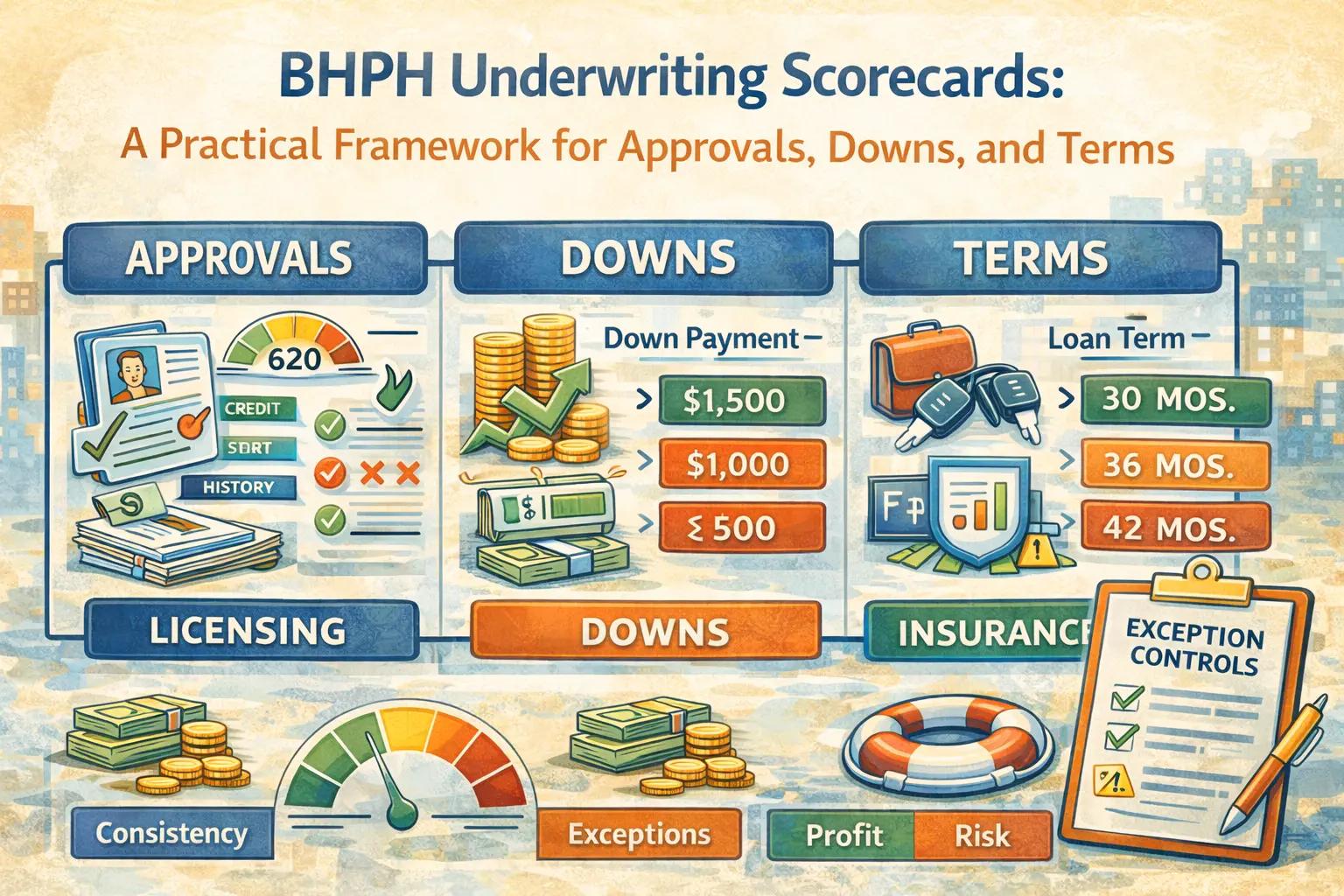
4. Developing Your Custom RTO Scorecard
A custom RTO scorecard is your most powerful tool for consistent, objective underwriting.
4.1 Weighting Different Factors
- Assign scores to each underwriting pillar (e.g., Income Stability might be 30%, Residence Stability 20%, etc.).
- Develop a minimum qualifying score for approval, and tiered scores for different down payment requirements or contract terms.
4.2 Identifying Red Flags and Fraud Indicators
- Inconsistent information on application.
- Unverifiable employment or residence.
- Reluctance to provide references.
- Recent, unexplained significant changes in employment or residence.
- Multiple recent inquiries at other dealerships.
4.3 The Role of the Sales Team in Initial Screening
- Train sales staff to understand basic underwriting criteria.
- Empower them to ask probing questions to uncover stability indicators early.
- Initial screening helps pre-qualify customers, saving time for the underwriting team.
5. Structuring the Deal: Optimizing for Risk and Customer Success
Underwriting isn't just about saying "yes" or "no"; it's about structuring the deal for mutual success.
5.1 Down Payments
- Risk-Tiered: Higher-risk customers may require larger down payments to demonstrate commitment and reduce exposure.
- Source of Funds: Verify down payment sources to prevent fraud.
5.2 Payment Frequency
- Align payments (weekly, bi-weekly) with customer pay cycles for maximum convenience and adherence.
5.3 Contract Terms
- Match terms to vehicle value and customer capacity. Shorter terms can reduce overall risk.
- Consider value-added products (VAPs) like GAP or extended warranties to protect both customer and collateral.
6. Monitoring and Adapting Underwriting Guidelines
RTO underwriting is an iterative process. Your scorecard and guidelines should evolve.
- Track Portfolio Performance: Regularly review delinquency rates, charge-offs, and recovery rates by scorecard segment.
- Identify Trends: Are certain applicant profiles performing better than others?
- Adjust & Refine: Based on performance data, adapt your weighting factors, approval thresholds, and deal structures.
7. How DealerClick Enhances RTO Underwriting
DealerClick’s RTO software is engineered to support a sophisticated, non-FICO-centric underwriting process, empowering your dealership to build a resilient portfolio:
- Customizable RTO Scorecards: Build and implement your unique scorecard within the system, weighting factors and automating approval tiers.
- Integrated Verification Tools: Streamline income, residence, and employment verification processes.
- Detailed Applicant Profiles: Centralize all applicant data, notes, and documents for a holistic view.
- Deal Structuring Flexibility: Easily adjust down payments, payment frequency, and terms to align with risk assessment.
- Reporting & Analytics: Track key underwriting metrics and portfolio performance to continuously refine your guidelines.
- Compliance Support: Ensures consistent application of rules, reducing discrimination risks and maintaining audit trails.
By leveraging DealerClick, RTO dealers can move beyond the limitations of traditional credit scores, make smarter underwriting decisions, and build a profitable portfolio that serves the unique needs of the subprime market.
Conclusion: Building a Resilient RTO Portfolio with Smarter Underwriting
In the dynamic RTO landscape, success is defined not by how many cars you move, but by the health and resilience of your portfolio. By moving beyond the confines of traditional credit scores and embracing a nuanced underwriting approach—one that prioritizes income, residence, and job stability, coupled with astute behavioral insights—dealers can unlock vast opportunities. Developing a custom RTO scorecard, structuring deals strategically, and continuously monitoring performance are the cornerstones of this success. With the right processes and a powerful technology partner like DealerClick, RTO dealerships can confidently navigate the subprime market, build strong customer relationships, and cultivate a truly resilient and profitable business.
Frequently Asked Questions (FAQs)
Why is RTO underwriting different from traditional auto loans?
RTO underwriting differs because it caters to subprime customers often overlooked by traditional lenders. Instead of relying heavily on FICO scores, RTO underwriting focuses on current stability (income, residence, job), capacity to pay, and behavioral indicators. This approach better assesses the unique risk profile of RTO customers, who might have past credit issues but are currently capable and willing to make payments.
What are the "Key Underwriting Pillars" for RTO?
The key underwriting pillars for RTO typically include: Income Stability (verifiable, consistent income), Residence Stability (long-term address, verified by landlord/utilities), Job Stability (consistent employment history), Verifiable References (personal and professional), and realistic Debt-to-Income (DTI) and Payment-to-Income (PTI) Ratios. These factors provide a comprehensive picture of a customer's current capacity and character.
How can a custom RTO scorecard improve underwriting?
A custom RTO scorecard allows dealerships to assign specific weights to the underwriting pillars that are most predictive of success in their RTO market. This objective tool ensures consistency in decision-making, reduces bias, helps identify red flags, and allows for tiered deal structuring (e.g., varying down payments) based on a calculated risk profile, leading to a more resilient portfolio.
How does DealerClick support RTO underwriting?
DealerClick's RTO software enhances underwriting by allowing dealers to build and implement customizable RTO scorecards, centralize all applicant data and verification documents, and offer flexible deal structuring. It provides integrated tools for income and residence verification, and robust reporting to monitor underwriting performance, enabling continuous refinement of guidelines.
Can RTO underwriting help prevent fraud?
Yes, a robust RTO underwriting process is a strong defense against fraud. By meticulously verifying income, employment, and residence, checking references, and identifying inconsistent information or red flags, dealers can significantly reduce their exposure to fraudulent applications. A structured process makes it harder for fraudsters to exploit loopholes.
Stay Updated
Get the latest auto dealer insights delivered straight to your inbox.
No spam. Unsubscribe anytime.