LHPH Financial Model: Unit Economics, Downtime Math, and Recon ROI
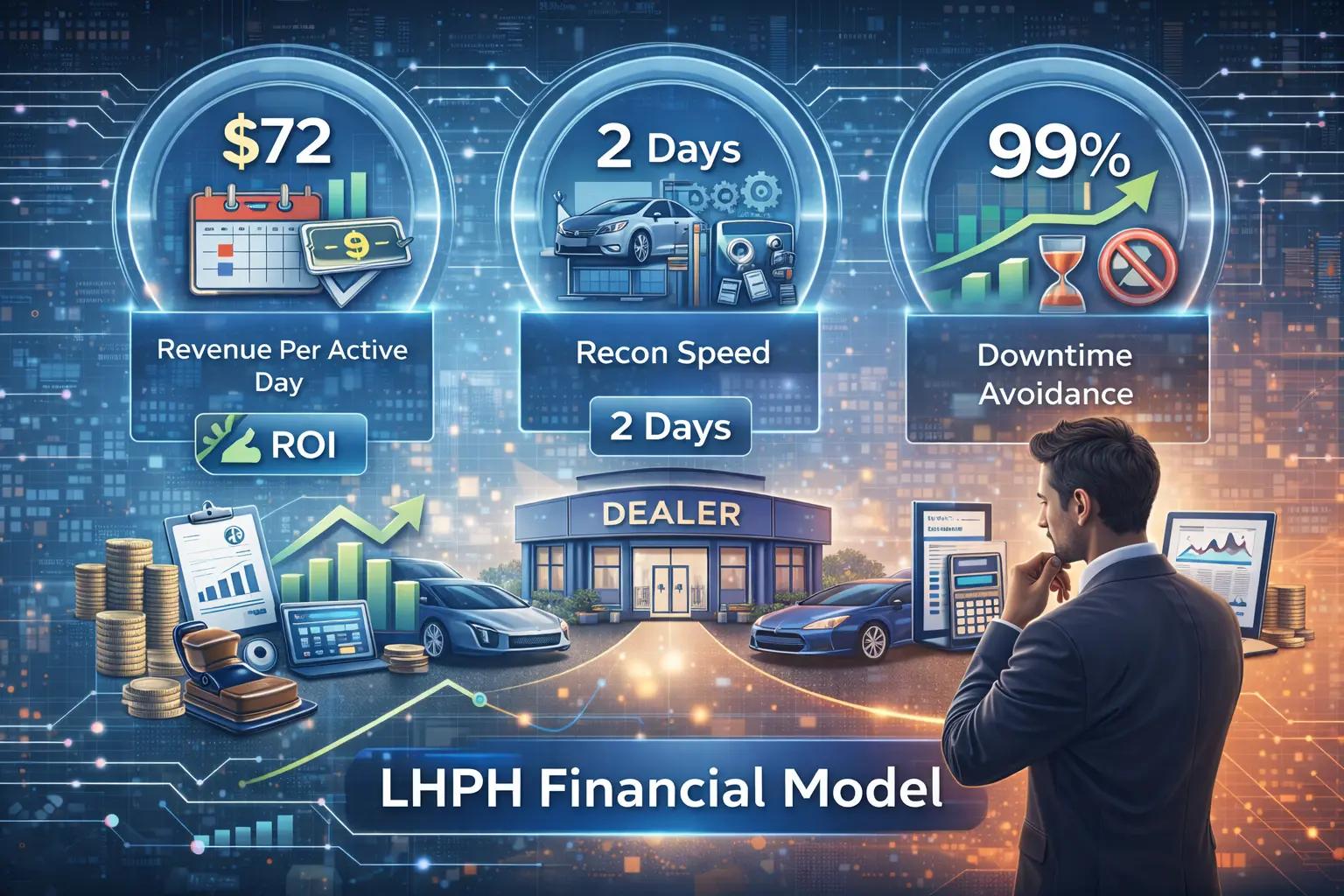
LHPH success hinges on understanding key financial drivers like revenue per active day, recon speed, and downtime avoidance. This post provides a simple, actionable financial model for dealers.
In the world of independent auto dealerships, Lease-Here Pay-Here (LHPH) models offer a powerful path to profitability, but only when driven by a robust financial understanding. Moving beyond surface-level metrics, true LHPH success is rooted in mastering unit economics, minimizing downtime, and optimizing reconditioning (recon) return on investment (ROI). For a comprehensive overview of the LHPH landscape and its operational differences from BHPH, delve into our pillar post: The Future of LHPH (Lease-Here Pay-Here): How It Compares to BHPH and How to Run Both Models Efficiently. This article provides a clear, simple financial model to help dealers understand and amplify their LHPH profits.
The Problem: Hidden Costs and Unoptimized Returns in LHPH
Many LHPH dealerships operate without a clear, granular understanding of their financial model, often leading to hidden costs and unoptimized returns. The unique asset-centric nature of LHPH means that traditional BHPH financial metrics, focused primarily on note performance, can be misleading. Without a sharp focus on unit economics, dealers risk making decisions that erode profitability, such as:
- Underestimating Downtime Costs: Each day a vehicle sits idle between leases represents lost revenue, yet these costs are frequently overlooked or inaccurately calculated.
- Inefficient Recon Spending: Investing in reconditioning without a clear ROI framework can lead to overspending or underspending, both of which negatively impact asset profitability.
- Ignoring Revenue Per Active Day: If a vehicle isn't generating lease income, it's a liability. Failing to track and maximize "revenue per active day" leaves significant profit on the table.
This lack of precise financial modeling can obscure the true performance of an LHPH portfolio, hindering strategic growth and decision-making.
The Solution: A Simple, Actionable LHPH Financial Model
The solution to maximizing LHPH profitability lies in adopting a simple yet powerful financial model focused on three core pillars: Unit Economics, Downtime Math, and Recon ROI. By systematically tracking and optimizing these areas, dealers can gain unparalleled clarity into their LHPH operations. This model empowers proactive decision-making, transforming potential profit leaks into drivers of sustained financial success.
This actionable financial framework provides the tools to:
- Accurately measure the profitability of each lease asset.
- Identify and quantify the true cost of vehicle downtime.
- Evaluate the effectiveness of reconditioning investments.
Embracing this model ensures that every vehicle in your LHPH fleet is a strategic asset, contributing optimally to your dealership’s overall financial health.
Key Benefits of Mastering Your LHPH Financial Model
A deep understanding and proactive management of your LHPH financial model delivers significant advantages:
- Maximized Asset Profitability: By tracking revenue per active day, you ensure each vehicle in your fleet is optimized to generate maximum income, preventing revenue loss from idle inventory.
- Precise Cost Control: Detailed downtime math and recon ROI analysis allow you to identify and mitigate hidden costs, ensuring every dollar spent on reconditioning and maintenance contributes positively to the bottom line.
- Improved Strategic Planning: A clear financial picture enables better decision-making regarding inventory acquisition, pricing strategies, lease terms, and operational workflows, fostering sustainable growth.
- Enhanced Cash Flow: Optimized asset turnover and efficient recon processes contribute to a healthier, more predictable cash flow, vital for business stability and expansion.
- Reduced Financial Risk: Understanding the true unit economics helps in risk assessment, allowing you to structure deals that align with profitability targets and minimize potential losses.
- Stronger Reporting and Valuation: Transparent, data-driven financial insights provide a solid foundation for internal reporting and can significantly enhance the valuation of your LHPH portfolio, should you consider a sale or financing.
How It Works: Deconstructing the LHPH Financial Model
Mastering your LHPH financial model involves understanding and actively managing a few critical equations and metrics.
1. The Unit Economics Equation: Revenue Per Active Day
The most fundamental metric for LHPH success is Revenue Per Active Day (RPAD). This measures how much money each vehicle generates for every day it is leased out to a customer.
RPAD = (Total Lease Revenue / Number of Active Lease Days)
To maximize RPAD, you need to optimize:
- Lease Revenue: This includes upfront fees, monthly payments, and any end-of-lease charges.
- Active Lease Days: This means minimizing the time a vehicle spends not being leased (i.e., reducing downtime).
By focusing on RPAD, you shift your mindset from merely collecting payments to maximizing the productive life and revenue generation of each asset.
2. Downtime Math: How Idle Days Kill Margin
Downtime is the silent killer of LHPH profitability. Every day a vehicle is not generating revenue, it's costing you money in carrying costs (insurance, depreciation, lot fees) and lost opportunity. For strategies on selecting inventory to minimize downtime and maximize turns, refer to our guide on LHPH Inventory Strategy: Choosing Vehicles That Survive Frequent Turns.
Cost of Downtime Per Vehicle Per Day = (Daily Carrying Cost) + (Lost RPAD)
Example: If a vehicle’s daily carrying cost is $10 and its potential RPAD is $30, every idle day costs $40. Ten days of downtime equals $400 lost from that single asset.
Strategies to minimize downtime include:
- Efficient lease-end processes (inspections, returns).
- Rapid reconditioning cycles.
- Proactive customer communication to manage lease maturities.
3. Recon ROI Model: Spend Now vs. Churn Later
Reconditioning is a necessary investment in LHPH, but it needs to be strategic. The Recon ROI helps you determine if your reconditioning spend is generating a positive return by enabling a quicker re-lease at a profitable rate.
Recon ROI = (Increased Revenue from Faster Re-lease + Reduced Customer Complaints) / (Total Recon Cost)
Consider:
- Spend enough to make it lease-ready: Skimping on recon can lead to extended downtime, customer dissatisfaction, and higher churn.
- Don't overspend: Identify the optimal level of recon that maximizes re-lease potential without unnecessary expense.
- Track costs: Accurately track parts, labor, and external services for each recon job.
4. Payment Frequency and Term Effects on Total Revenue and Risk
The structure of your lease agreements directly impacts your financial model.
- Payment Frequency: Weekly or bi-weekly payments can improve cash flow stability and potentially reduce risk by identifying issues earlier.
- Term Length: Shorter terms can lead to more frequent asset turns and higher overall revenue if recon and downtime are managed well. Longer terms might offer lower monthly payments but tie up the asset longer.
5. What Data Must Be Tracked to Avoid Guessing
To effectively implement this financial model, you need accurate, real-time data on:
- Individual vehicle lease history (start/end dates, payments received).
- Downtime periods for each vehicle.
- Detailed reconditioning costs per vehicle.
- Customer payment performance metrics (e.g., delinquency, autopay).
How DealerClick Reporting Supports Confident Decisions
DealerClick's advanced reporting capabilities are designed to provide the precise financial insights needed to master your LHPH financial model. Our unified platform tracks every aspect of your LHPH operations, from detailed vehicle histories and reconditioning costs to comprehensive payment analytics. This data is synthesized into actionable dashboards and reports, empowering you to calculate RPAD, analyze downtime, and evaluate Recon ROI with confidence. With DealerClick, you have the reliable data to make confident financial decisions and optimize your LHPH product for reporting.
Conclusion: Unlocking LHPH Profitability Through Financial Mastery
For independent auto dealers, transforming LHPH into a consistently profitable venture demands more than just managing collections; it requires financial mastery. By deeply understanding and proactively managing unit economics, downtime math, and reconditioning ROI, dealerships can unlock significant revenue potential. This data-driven approach, centered on metrics like Revenue Per Active Day, ensures that every vehicle asset is optimized for maximum financial contribution.
Embracing a robust LHPH financial model, supported by powerful reporting tools like DealerClick, empowers dealers to make informed strategic decisions, reduce hidden costs, and confidently scale their operations. Don't just guess at profitability – measure it, optimize it, and grow.
Ready to build a stronger financial model for your LHPH dealership?
Frequently Asked Questions (FAQs)
What is "unit economics" in the context of LHPH?
In LHPH, unit economics refers to the profitability generated by a single lease asset (vehicle). It encompasses all revenue generated by that vehicle (lease payments, fees) minus all associated costs (acquisition, reconditioning, carrying costs, downtime costs) over its active lease life.
How does vehicle downtime impact LHPH profitability?
Vehicle downtime directly impacts LHPH profitability by representing lost revenue opportunities. Every day a vehicle sits idle between leases or during reconditioning, it incurs carrying costs (insurance, depreciation) without generating any income, effectively eroding the potential profit margin for that asset.
What is Recon ROI and why is it important for LHPH?
Recon ROI (Return on Investment for Reconditioning) measures the financial benefit gained from investing in a vehicle's reconditioning against the cost of that reconditioning. It's crucial for LHPH because it helps determine if the money spent on repairs and maintenance leads to faster re-lease cycles, higher lease rates, or reduced customer issues, thereby increasing overall asset profitability.
How can DealerClick help improve my LHPH financial model?
DealerClick provides integrated tools and robust reporting capabilities that centralize data on vehicle history, reconditioning costs, payment performance, and downtime. This allows dealers to accurately calculate key financial metrics like Revenue Per Active Day and Recon ROI, providing the insights needed to optimize operations and make data-driven financial decisions.
Where can I learn more about the strategic differences between LHPH and BHPH?
For a detailed analysis of how LHPH and BHPH models compare, including their unique operational and financial implications, refer to our comprehensive pillar post: "The Future of LHPH (Lease-Here Pay-Here): How It Compares to BHPH and How to Run Both Models Efficiently".
Stay Updated
Get the latest auto dealer insights delivered straight to your inbox.
No spam. Unsubscribe anytime.