LHPH KPIs That Actually Predict Profit (and What “Good” Looks Like)
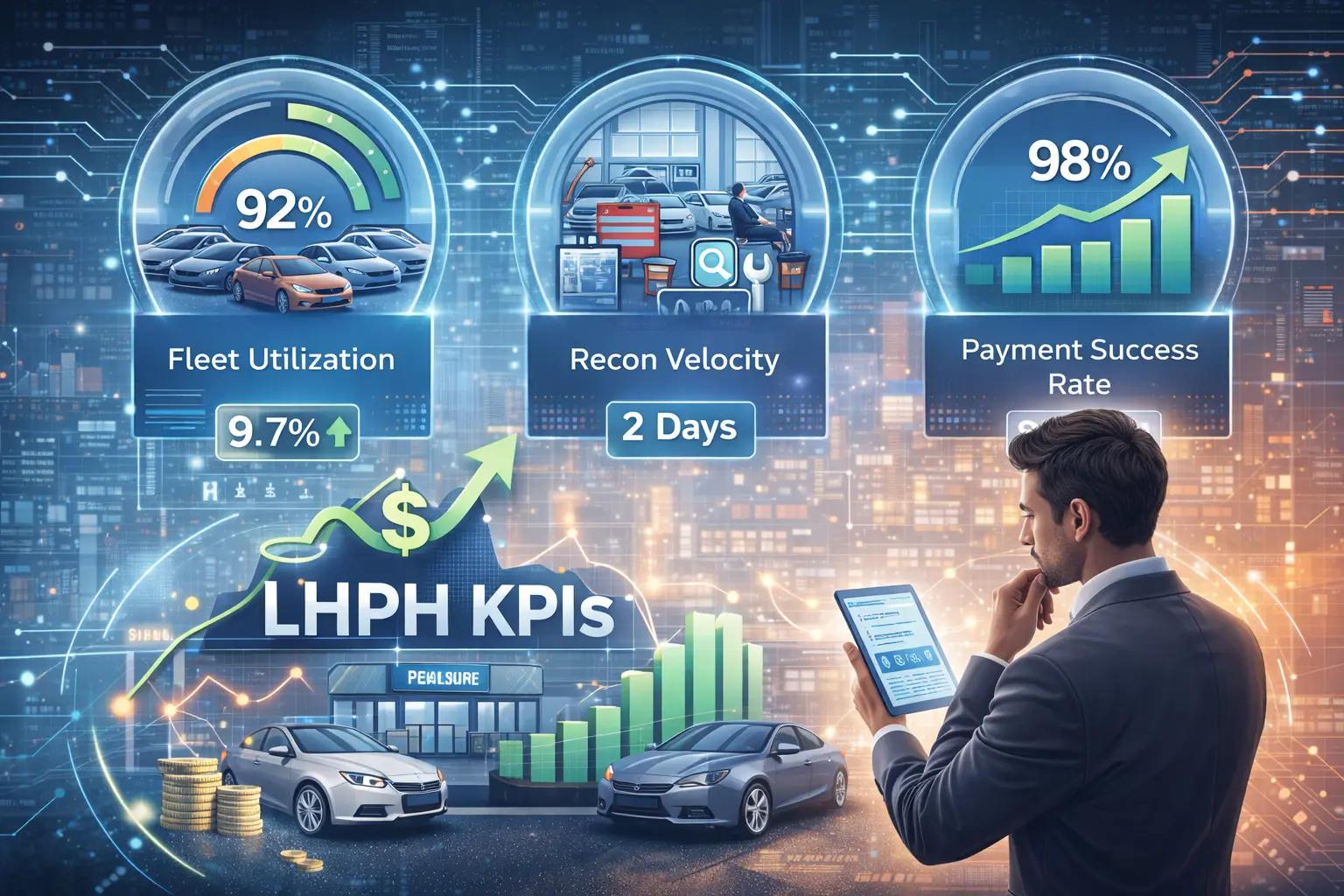
Many dealers track collections, but miss the key performance indicators that truly drive Lease-Here Pay-Here (LHPH) profitability: fleet utilization, recon velocity, and payment success rates.
In the rapidly evolving landscape of independent auto dealerships, Lease-Here Pay-Here (LHPH) models are gaining significant traction. To understand how LHPH compares to traditional Buy-Here Pay-Here (BHPH) models and how to run both efficiently, refer to our comprehensive guide: The Future of LHPH (Lease-Here Pay-Here): How It Compares to BHPH and How to Run Both Models Efficiently. While BHPH operators have long relied on traditional collection metrics, LHPH demands a nuanced understanding of performance indicators. The true measure of profitability in an LHPH operation extends beyond simple payment collection, delving deep into asset lifecycle, customer engagement, and operational velocity.
The Problem: Beyond Traditional Collections Metrics for LHPH
Many independent dealerships, accustomed to BHPH models, often apply the same set of Key Performance Indicators (KPIs) to their LHPH operations. For a detailed look at effective BHPH strategies, see our BHPH Guide. This oversight can lead to a significant misinterpretation of an LHPH portfolio's health and profitability. Traditional collections metrics, while vital for BHPH, fail to capture the unique dynamics of a lease model, which is fundamentally inventory-centric rather than purely portfolio-centric.
The core challenge lies in the shift from owning a receivable to managing an asset. Without tracking KPIs related to vehicle utilization, reconditioning efficiency, and the nuances of lease payments, dealers risk operational blind spots, missed opportunities for revenue generation, and an inability to accurately predict future profitability. This can result in costly downtime, inefficient inventory turns, and ultimately, a less profitable LHPH program.
The Solution: A Strategic Focus on LHPH-Specific KPIs
The path to maximizing LHPH profitability lies in adopting a specialized framework of KPIs that align with the model's asset-centric nature. By shifting focus from solely collections to a holistic view encompassing payment performance, asset lifecycle, and customer operations, dealerships can gain actionable insights. This strategic approach ensures that every aspect of the LHPH cycle, from vehicle acquisition to lease-end and re-lease, is optimized for efficiency and financial return.
Implementing LHPH-specific KPIs allows dealers to proactively identify bottlenecks, refine processes, and make data-driven decisions that enhance fleet utilization, accelerate reconditioning, and improve customer retention. This targeted metric tracking transforms potential operational chaos into a streamlined, highly profitable leasing program.
Key Benefits of Tracking LHPH-Specific KPIs
Optimizing your LHPH operations through tailored KPIs delivers substantial benefits that directly impact your bottom line and long-term sustainability:
- Predictive Profitability: Move beyond historical collections data to forecast future revenue more accurately by understanding trends in fleet utilization, recon speed, and payment success rates. This allows for proactive financial planning and risk mitigation. For a deeper dive into the financial implications of these metrics, explore our guide on the LHPH Financial Model: Unit Economics, Downtime Math, and Recon ROI.
- Enhanced Asset Utilization: By closely monitoring downtime and turn frequency, dealerships can ensure their valuable assets are on the road generating revenue for more days, directly boosting profitability per vehicle.
- Streamlined Operations and Efficiency: Tracking recon cycle times and cost per turn highlights inefficiencies, enabling process improvements that reduce operational expenses and accelerate vehicle readiness for the next lease.
- Improved Customer Retention and Payment Performance: KPIs like autopay penetration and promise-to-pay kept rates provide insights into customer behavior, allowing for targeted communication strategies and enhanced payment consistency.
- Data-Driven Decision Making: Access to specific, actionable LHPH metrics empowers management to make informed choices on inventory acquisition, reconditioning strategies, staffing levels, and overall portfolio management, leading to sustainable growth.
- Clearer Audit Trails and Compliance: Detailed reporting on payment success, dispute rates, and resolution times helps maintain a clean audit trail, crucial for compliance and demonstrating the health of your LHPH portfolio.
How It Works: Implementing Robust LHPH KPI Tracking
To effectively predict profit and optimize an LHPH program, dealers must systematically track KPIs across several critical categories.
Category A: Payment KPIs
These metrics provide deep insight into the financial health of your lease portfolio and customer payment behavior.
- Current Rate: The percentage of accounts that are current on their payments. This is a foundational health indicator.
- Delinquency Buckets & Roll Rates: Track the percentage of accounts falling into 30, 60, 90+ day delinquency buckets, and how many "roll" from one bucket to the next. This helps predict future charge-offs.
- Payment Success Rate (ACH/Card Success): The percentage of attempted electronic payments that are successfully processed. A high success rate indicates robust payment infrastructure and customer compliance.
- Autopay Penetration: The percentage of customers enrolled in automatic payments. Higher penetration typically correlates with lower delinquency.
- Promise-to-Pay Kept Rate: For customers who make a promise to pay, track how often they fulfill it. This measures collections effectiveness and customer reliability.
Category B: Asset Lifecycle KPIs
These KPIs are unique to LHPH and measure the efficiency of your vehicle fleet management.
- Days Idle (Downtime): The number of days a vehicle sits idle between leases or during reconditioning. Lower downtime directly increases revenue-generating days.
- Recon Cycle Time: The average time it takes to recondition a vehicle from turn-in to being lease-ready. Faster cycle times mean quicker re-leasing.
- Turn Frequency (Leases per Vehicle per Period): How many times a single vehicle is leased within a given period. Higher frequency indicates efficient asset utilization.
- Cost per Turn (Recon + Downtime): The total cost incurred for reconditioning and the lost revenue due to downtime for each vehicle turn. This helps evaluate reconditioning strategies.
Category C: Customer Operations KPIs
Understanding customer engagement and dispute resolution is crucial for LHPH sustainability.
- Contact Rate: The percentage of customers successfully contacted regarding payments or lease terms.
- Dispute Rate: The frequency of customer disputes related to payments, fees, or vehicle condition. High rates may indicate communication issues or unclear terms.
- Resolution Time: The average time taken to resolve a customer dispute. Efficient resolution improves satisfaction and reduces churn.
KPI Dashboard Template
| KPI Category | Specific KPI | What It Measures | Why It Matters for LHPH Profit |
|---|---|---|---|
| Payment Performance | Current Rate | Percentage of active leases current on payments | Direct indicator of portfolio health and immediate cash flow |
| Payment Performance | Autopay Penetration | % of customers on recurring payments | Predictor of payment consistency; reduces collections effort |
| Asset Lifecycle | Days Idle (Downtime) | Time vehicle sits between leases/recon | Direct revenue loss; impacts vehicle ROI |
| Asset Lifecycle | Recon Cycle Time | Time from turn-in to lease-ready | Impacts inventory availability and re-lease speed |
| Customer Operations | Dispute Rate | Frequency of customer payment/lease disputes | Indicates clarity of terms and potential churn risk |
Common KPI Traps
Be wary of "vanity metrics" that look good but don't drive action. Inconsistent definitions across your team or over time can also skew data. Focus on metrics that are actionable and clearly linked to profitability and operational efficiency.
How DealerClick Supports KPI Tracking and Reporting
DealerClick provides a unified platform that integrates payment processing, inventory management, and customer communication, ensuring all critical data points for LHPH KPIs are captured accurately and in real-time. This eliminates data silos and provides comprehensive reporting dashboards tailored to the unique demands of LHPH operations. Learn more about our LHPH product features here.
Conclusion: Driving LHPH Profit with Data-Driven Decisions
For independent auto dealers, mastering LHPH profitability requires a strategic pivot from traditional BHPH metrics to a specialized set of Key Performance Indicators. By focusing on payment performance, asset lifecycle efficiency, and robust customer operations, dealerships can unlock the full potential of their leasing programs. KPIs related to fleet utilization, reconditioning velocity, and payment success rates are not just numbers; they are predictive tools that empower proactive management and sustainable growth.
Implementing a comprehensive KPI strategy, supported by technology like DealerClick, transforms your LHPH operation from reactive to strategic, ensuring every vehicle, every payment, and every customer interaction contributes to a healthier, more profitable portfolio.
Ready to optimize your LHPH operations with actionable KPIs?
Frequently Asked Questions (FAQs)
Why do LHPH KPIs differ from BHPH?
LHPH focuses on managing the lifecycle and utilization of an asset (the vehicle), while BHPH primarily focuses on managing the performance and collection of a receivable (the loan note). This fundamental difference means LHPH metrics emphasize areas like vehicle downtime, reconditioning cycles, and recurring payment success, in addition to traditional delinquency rates.
What is "recon velocity" in LHPH?
Recon velocity refers to the speed and efficiency with which a vehicle is reconditioned and made ready for its next lease after a previous lease ends or a return occurs. It's a critical asset lifecycle KPI, as faster recon velocity directly reduces vehicle downtime and increases the revenue-generating days for each asset.
How does autopay penetration impact LHPH profitability?
Autopay penetration is a key payment KPI because it significantly increases payment consistency and reduces the administrative burden of collections. Higher autopay rates lead to fewer missed payments, lower delinquency, improved cash flow predictability, and ultimately, a more stable and profitable LHPH portfolio.
Can DealerClick track both LHPH and BHPH KPIs?
Yes, DealerClick is designed as a unified platform to support both BHPH and LHPH models. It provides integrated tools for payment management, inventory tracking, customer relationship management, and reporting, allowing dealerships to track and analyze the distinct KPIs relevant to each financing model from a single source of truth.
Where can I find more information on LHPH vs BHPH strategy?
For a comprehensive comparison and decision framework on LHPH vs. BHPH models, including insights into compliance and operational realities, refer to our main pillar post: "The Future of LHPH (Lease-Here Pay-Here): How It Compares to BHPH and How to Run Both Models Efficiently".
Stay Updated
Get the latest auto dealer insights delivered straight to your inbox.
No spam. Unsubscribe anytime.