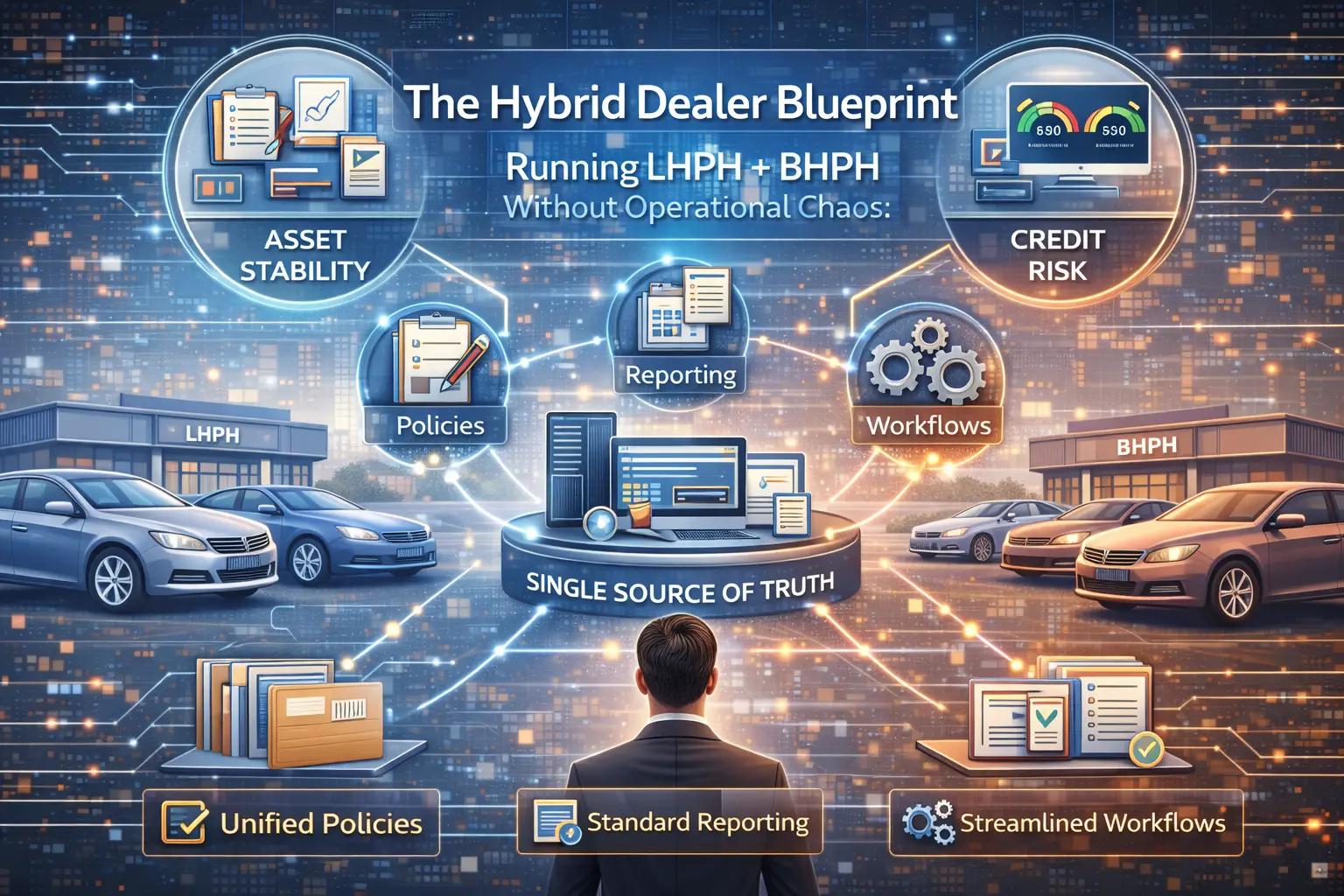
The Hybrid Dealer Blueprint: Running LHPH + BHPH Without Operational Chaos
Unlock the blueprint for successfully running both LHPH and BHPH models without chaos. Hybrid works when policies, reporting, and workflows are standardized, driven by a single source of truth.
In today’s dynamic automotive market, independent dealerships are increasingly seeking flexibility to serve diverse customer segments and adapt to varying inventory types. This often leads to the adoption of a hybrid approach, seamlessly blending Lease-Here Pay-Here (LHPH) and Buy-Here Pay-Here (BHPH) models. While offering immense strategic advantages, running both models can quickly devolve into operational chaos without a clear blueprint. For a foundational understanding of the strategic advantages and operational distinctions between LHPH and BHPH, explore our pillar post: The Future of LHPH (Lease-Here Pay-Here): How It Compares to BHPH and How to Run Both Models Efficiently. This guide provides a comprehensive blueprint for achieving this delicate balance, ensuring that your hybrid operation is driven by standardized policies, consistent reporting, and a single source of truth.
The Problem: Operational Chaos in Uncoordinated Hybrid Models
The promise of a hybrid LHPH + BHPH model is powerful: flexibility to match the right financing solution to every customer and vehicle. However, without a meticulously planned and executed strategy, this flexibility can quickly turn into operational chaos. The most common failure point arises when dealerships attempt to run both models using disconnected systems and inconsistent processes, leading to:
- Data Fragmentation: Payments tracked in one system, contracts on a shared drive, inventory status in spreadsheets, and customer communication across various platforms. This siloed data prevents a holistic view of operations.
- Reporting Inaccuracies: Inconsistent definitions for key metrics across different systems make it impossible to generate accurate, unified reports, leading to poor strategic decisions.
- Compliance Gaps: Without standardized documentation and workflows for both models, dealerships become vulnerable to compliance breaches and audit risks.
- Customer Disputes: Conflicting information or unclear expectations arising from varied processes can lead to customer confusion and dissatisfaction.
- Operational Blind Spots: Lack of a single source of truth means management operates without full visibility, making it difficult to identify inefficiencies or emerging problems.
This uncoordinated approach not only negates the benefits of a hybrid model but actively drains resources and hinders scalable growth.
The Solution: A Unified, Standardized Hybrid Blueprint
The blueprint for a successful hybrid LHPH + BHPH operation is built on standardization and a single source of truth. By consolidating data, defining consistent policies, and streamlining workflows across both models within one integrated platform, dealerships can eliminate chaos and harness the full power of their dual financing strategy. This approach ensures operational efficiency, robust compliance, and accurate reporting, turning flexibility into a sustainable competitive advantage.
A unified platform allows for a seamless flow of information between sales, finance, operations, and collections, ensuring everyone works from the same playbook. This eliminates data fragmentation, reduces manual errors, and provides management with real-time, actionable insights into the entire portfolio. The result is a hybrid operation that is not only efficient and compliant but also poised for scalable growth.
Key Benefits of a Hybrid Dealer Blueprint
Implementing a well-structured hybrid blueprint for LHPH + BHPH operations delivers numerous strategic and operational advantages:
- Maximized Customer Reach: Offer tailored financing solutions for a wider range of customers, increasing sales opportunities and market penetration.
- Optimized Inventory Utilization: Match vehicles to the most suitable financing model (lease or sale), ensuring each asset generates maximum profitability based on its characteristics and market demand.
- Enhanced Operational Efficiency: Consolidate workflows and data into a single platform, eliminating redundant tasks, reducing manual errors, and improving cross-departmental coordination.
- Robust Compliance and Audit Readiness: Standardized policies, unified documentation, and clear audit trails across both models significantly reduce compliance risks and simplify regulatory reviews.
- Superior Data-Driven Decision Making: Access to consistent, accurate, and real-time reporting provides management with the insights needed for strategic planning, risk assessment, and performance optimization.
- Reduced Operational Costs: Streamlined processes and a single system of record minimize administrative overhead, staff training time, and the costs associated with managing disparate systems.
- Increased Flexibility and Adaptability: The ability to pivot between LHPH and BHPH as market conditions, customer profiles, or inventory types change, ensures your dealership remains agile and competitive. This adaptability extends to broader financial decisions, including your Portfolio Strategy for Special Finance: Hold vs Sell.
How It Works: Executing Your Hybrid Dealer Blueprint
Successfully running a hybrid LHPH + BHPH model requires careful planning and the right operational infrastructure.
1. Why Hybrid Is Becoming Normal
The market demands flexibility:
- Customer Segmentation: Different customers have different needs and credit profiles, making one-size-fits-all financing less effective.
- Capital Strategy: Hybrid models offer diverse revenue streams and risk profiles, allowing dealers to optimize their capital deployment.
- Inventory Diversity: Certain vehicles are better suited for leasing (e.g., those with higher residual value potential) while others are ideal for direct sale.
2. Segmentation Rules: Which Customers/Vehicles Go to Which Model
Establish clear, consistent criteria for guiding customers and vehicles into the appropriate financing model.
- Customer Credit Profile: Define score ranges, job stability, and income levels that typically align with either a lease or a purchase.
- Vehicle Characteristics: Use age, mileage, projected depreciation, and reconditioning costs to determine if a vehicle is better suited for an LHPH program or a BHPH sale.
- Dealer Objectives: Align segmentation with your current business goals (e.g., prioritize asset turnover with LHPH, or long-term note revenue with BHPH).
3. Where Hybrid Breaks (Split Payments, Docs, Inventory, Comms)
Avoid the common pitfalls that lead to chaos:
- Disconnected Systems: Payments managed in one tool, contracts stored separately, inventory tracking in spreadsheets.
- Inconsistent Policies: Different fee structures, grace periods, or communication protocols for each model.
- Lack of Unified Reporting: Inability to see consolidated performance across both portfolios.
4. Standardization Requirements
Implement uniform policies and procedures across your hybrid operations:
- One Fee Policy Framework: Standardize how fees are applied, disclosed, and collected, regardless of whether it's a lease or a sale.
- One Exception Policy: Create a consistent process for handling customer exceptions (e.g., late payments, payment deferrals) that applies across both models.
- One Communication and Documentation Standard: Ensure all customer communication (verbal and written) and all contractual documents adhere to a single set of quality and compliance standards.
5. Roles and Handoffs Across Sales/Ops/Collections/Service
Clearly define responsibilities and seamless transitions between departments:
- Sales: Trained to identify the best financing model for each customer early in the process.
- Finance: Experts in structuring both lease and sale deals compliantly and profitably.
- Operations/Collections: Equipped with tools and policies to manage payment cycles and customer interactions for both models.
- Service: Understands the different maintenance responsibilities for leased vs. sold vehicles.
6. Reporting Definitions That Must Be Consistent
Ensure that your data tells a coherent story across both models.
- Unified Metrics: Define key performance indicators (KPIs) that can be consistently applied or clearly contrasted between LHPH and BHPH, such as delinquency rates, acquisition costs, and customer retention.
- Centralized Dashboards: Leverage a single platform to view consolidated performance data, allowing for apples-to-apples comparisons and holistic insights.
How DealerClick Supports Hybrid Execution in One Platform
DealerClick is purpose-built to empower dealerships to run successful hybrid LHPH + BHPH operations from a single, integrated platform. Our solution provides the tools for consistent customer segmentation, standardized deal structuring, unified payment processing, and comprehensive reporting across both models. By eliminating data fragmentation and enforcing repeatable workflows, DealerClick ensures your hybrid strategy drives efficiency, profitability, and scalable growth. Discover how DealerClick's unified platform can transform your LHPH product features and seamlessly manage your BHPH guide operations.
Conclusion: Mastering the Hybrid Advantage
The hybrid LHPH + BHPH model represents a powerful strategic advantage for independent dealerships willing to implement it with discipline. The key to unlocking this potential lies in establishing a unified blueprint: standardizing policies, streamlining workflows, and leveraging a single source of truth for all operations. This proactive approach eliminates the chaos of disparate systems and inconsistent practices, allowing dealers to effectively segment customers, optimize inventory, and drive superior financial performance.
By embracing a comprehensive hybrid strategy, supported by integrated technology, your dealership can confidently navigate market complexities, expand your customer base, and build a resilient, highly profitable business model for the future.
Ready to build your dealership's hybrid blueprint for success?
Frequently Asked Questions (FAQs)
What is a "hybrid dealer blueprint"?
A hybrid dealer blueprint refers to a strategic framework that allows an independent dealership to effectively operate both Lease-Here Pay-Here (LHPH) and Buy-Here Pay-Here (BHPH) financing models simultaneously. The blueprint emphasizes standardized policies, unified workflows, and a single system of record to prevent operational chaos and maximize the benefits of both models.
Why are hybrid LHPH + BHPH models becoming more common?
Hybrid models are gaining traction because they offer greater flexibility to serve a broader range of customer credit profiles and optimize diverse inventory types. They allow dealerships to adapt to changing market conditions, leverage different capital strategies, and maximize profitability by matching the most suitable financing solution to each unique situation.
What are the biggest risks of running a hybrid model without a blueprint?
The biggest risks include data fragmentation across multiple disconnected systems, inconsistent reporting, compliance gaps due to varied policies, increased customer disputes from unclear expectations, and operational blind spots that prevent effective management. These issues can quickly erode profitability and hinder scalable growth.
How does standardization help manage a hybrid dealership?
Standardization is crucial for a hybrid dealership as it ensures consistency across policies, workflows, and communication for both LHPH and BHPH models. This reduces errors, improves efficiency, simplifies staff training, enhances compliance readiness, and creates a unified experience for customers, ultimately preventing operational chaos.
How does DealerClick support hybrid LHPH and BHPH operations?
DealerClick provides a single, integrated platform that supports all aspects of hybrid LHPH + BHPH operations. It offers tools for consistent customer segmentation, standardized deal structuring, unified payment processing, comprehensive reporting, and robust compliance features. This eliminates data silos and empowers dealerships to run both models efficiently and profitably.
Stay Updated
Get the latest auto dealer insights delivered straight to your inbox.
No spam. Unsubscribe anytime.