Powersports KPIs That Actually Predict Profit (and What 'Good' Looks Like)
Most dealers watch total sales, but the most profitable powersports stores in 2026 focus on internal velocity: unit reconditioning speed, parts turnover, and service absorption rates.
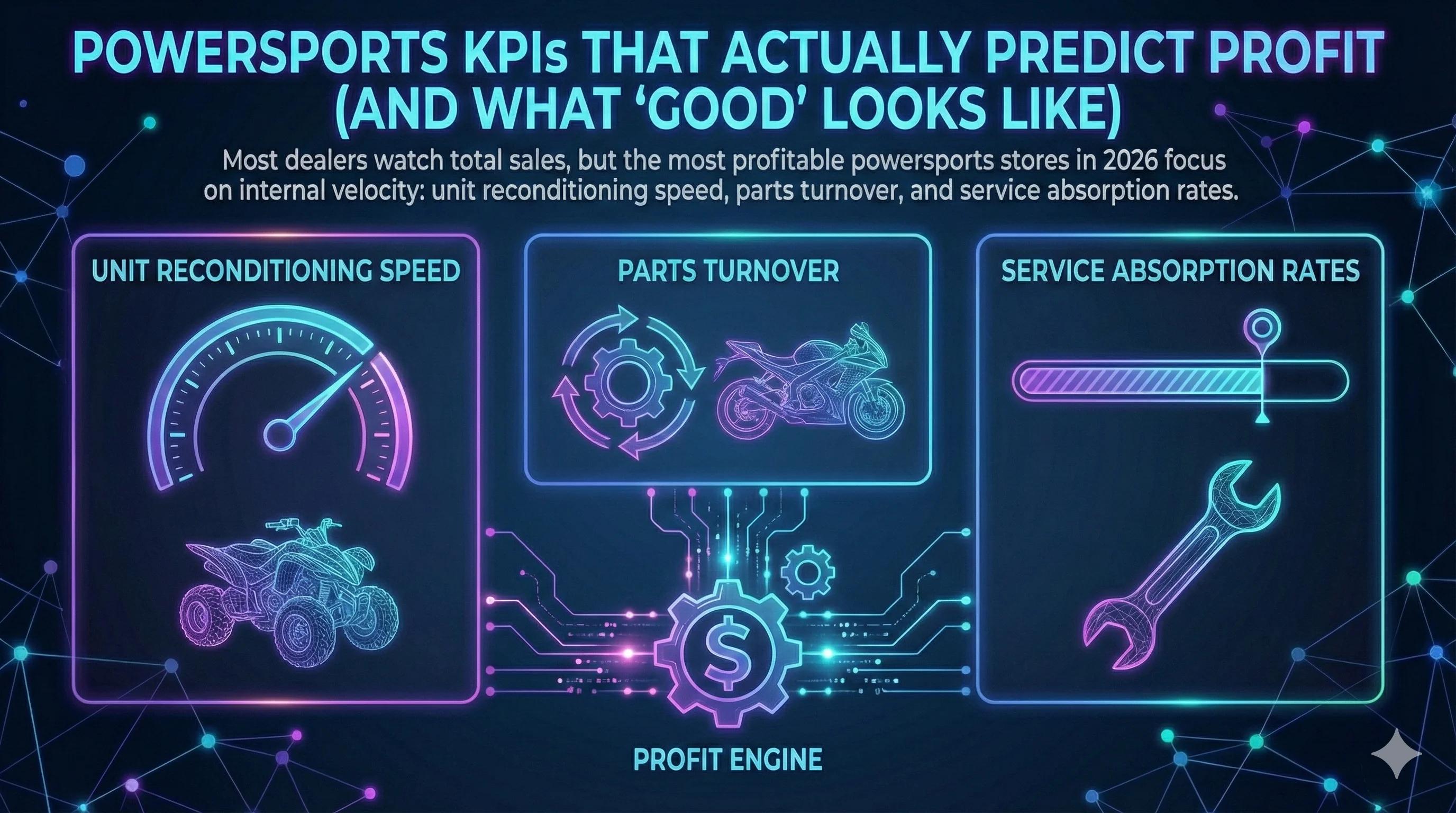
In the compressed-margin reality of 2026, knowing your "total sales number" isn't enough. The powersports dealerships that consistently outperform their competitors have shifted from vanity metrics to velocity metrics—tracking the internal operational rhythms that directly drive profitability. Modern powersports dealer management software provides the real-time reporting infrastructure to monitor these critical KPIs, transforming gut-feel management into data-driven precision.
This guide defines the essential KPI categories every powersports dealer should track, provides 2026 benchmarks for "good" performance by dealership size, and explains how your DMS should automate these reports so you can focus on action rather than spreadsheet maintenance.
Why Total Revenue Is a Vanity Metric in a Compressed-Margin 2026 Market
Revenue growth looks impressive on paper, but profitability tells the real story. In 2026's powersports market, dealers face:
- Compressed unit margins: Increased price transparency and online competition have squeezed gross profit per unit to historic lows
- Rising operational costs: Labor, facility expenses, and technology investments continue climbing
- Inventory carrying costs: Higher interest rates mean every day a unit sits unsold directly impacts profitability
- Service competition: Independent shops and mobile mechanics compete aggressively for maintenance and repair work
A dealership can grow revenue 20% while watching profitability decline if the underlying operational metrics are deteriorating. The most successful powersports dealers in 2026 recognize that velocity beats volume—moving units faster, turning parts inventory efficiently, and maximizing service department productivity generates more profit than simply selling more units.
The shift requires tracking the right metrics: the KPIs that actually predict whether your dealership will be profitable at month-end, not just busy.
Category A: Inventory Velocity
Your floor plan interest expense starts accruing the moment a unit arrives. Every day that passes before sale represents carrying cost, opportunity cost, and depreciation. Smart dealers obsess over inventory velocity metrics.
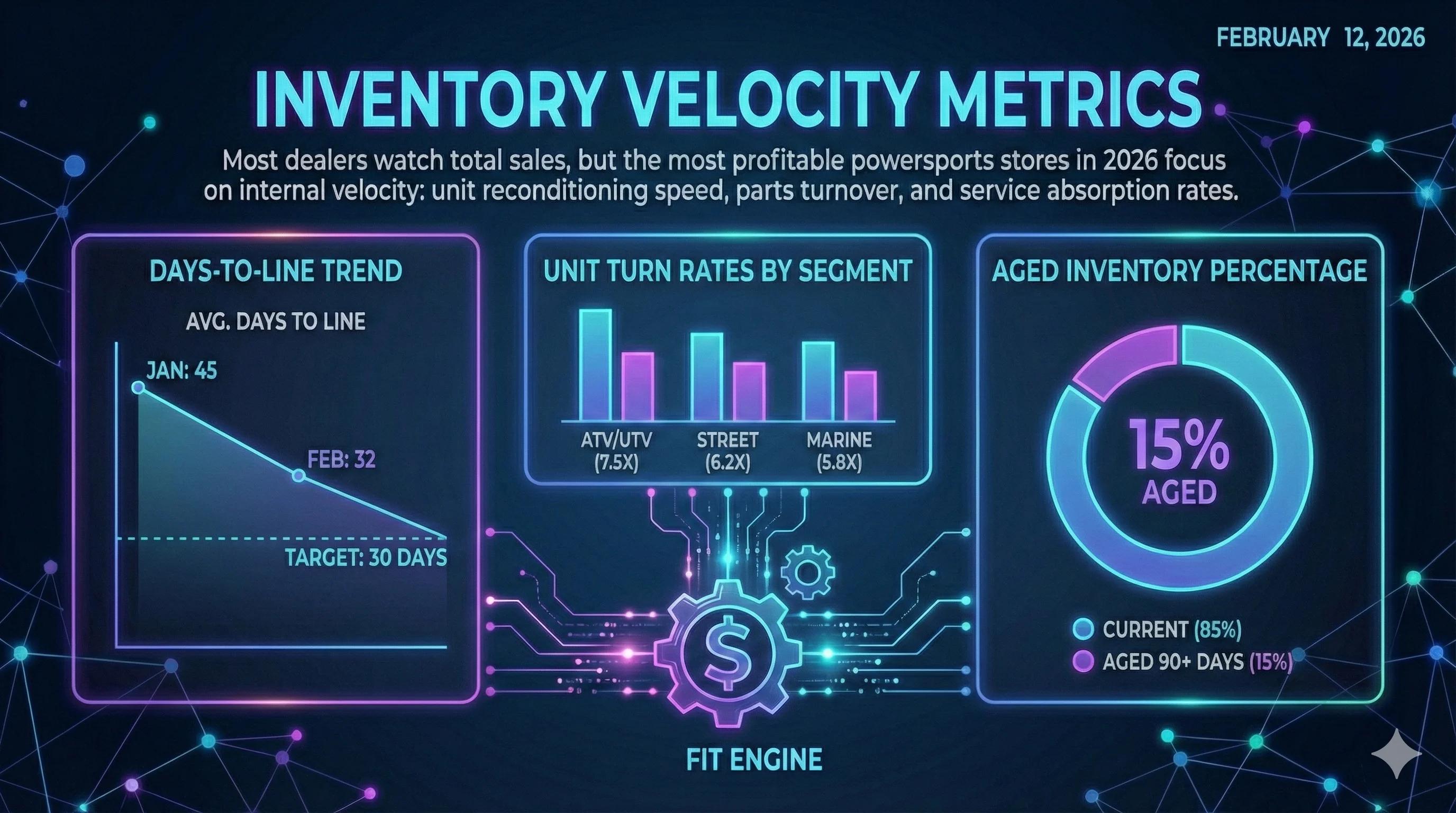
Days-to-Line (Intake to Website Live)
What it measures: The time elapsed from when a unit arrives at your dealership to when it's listed for sale on your website with complete information and photos.
Why it matters: Every day a unit sits "in process" is a day you can't sell it. Buyers shopping online won't wait for you to finish your intake workflow—they'll buy from a competitor whose inventory is already live.
2026 benchmarks:
- Excellent: 2-3 days
- Good: 4-5 days
- Needs improvement: 6-10 days
- Problem: 10+ days
How to improve: Implement mobile VIN decoding for instant spec population, automated service order generation for reconditioning, and integrated photo workflows that sync directly to your website. Modern powersports dealer software handles this entire process digitally.
Unit Turn Rate by Segment (ATV vs. Marine vs. Street)
What it measures: How many times per year you sell and replace your inventory in each major category.
Why it matters: Different segments have different natural turn rates. Street bikes typically turn faster than marine units. Understanding segment-specific performance helps you optimize stocking decisions and identify where capital is trapped.
2026 benchmarks (annual turns):
- ATVs/UTVs: 6-8 turns (excellent), 4-6 turns (good)
- Street motorcycles: 8-10 turns (excellent), 6-8 turns (good)
- Marine: 4-6 turns (excellent), 3-4 turns (good)
- Scooters/small displacement: 10-12 turns (excellent), 8-10 turns (good)
How to improve: Monitor aging reports weekly, adjust pricing proactively on slow movers, and use market data integrations to ensure your pricing remains competitive. Don't let pride in your original asking price cost you thousands in carrying costs.
Aged Inventory Percentage (60+ Days)
What it measures: The percentage of your floor plan units that have been in inventory for 60+ days.
Why it matters: Units that sit beyond 60 days typically require significant price adjustments to move, directly impacting gross profit. High aged inventory percentages signal pricing problems, stocking mismatch with market demand, or inadequate merchandising.
2026 benchmarks:
- Excellent: <15% of inventory aged 60+ days
- Good: 15-25%
- Needs improvement: 25-40%
- Problem: 40%+
How to improve: Implement automated aging alerts at 30, 45, and 60 days. Establish clear pricing action plans at each milestone. Consider strategic price reductions or manufacturer incentives before units becomes truly aged. Your DMS should flag these units prominently in daily reports.
Category B: Service & Parts KPIs
For many powersports dealerships, the service and parts departments represent the difference between overall profitability and just breaking even on unit sales. These departments should be profit centers, not cost centers.
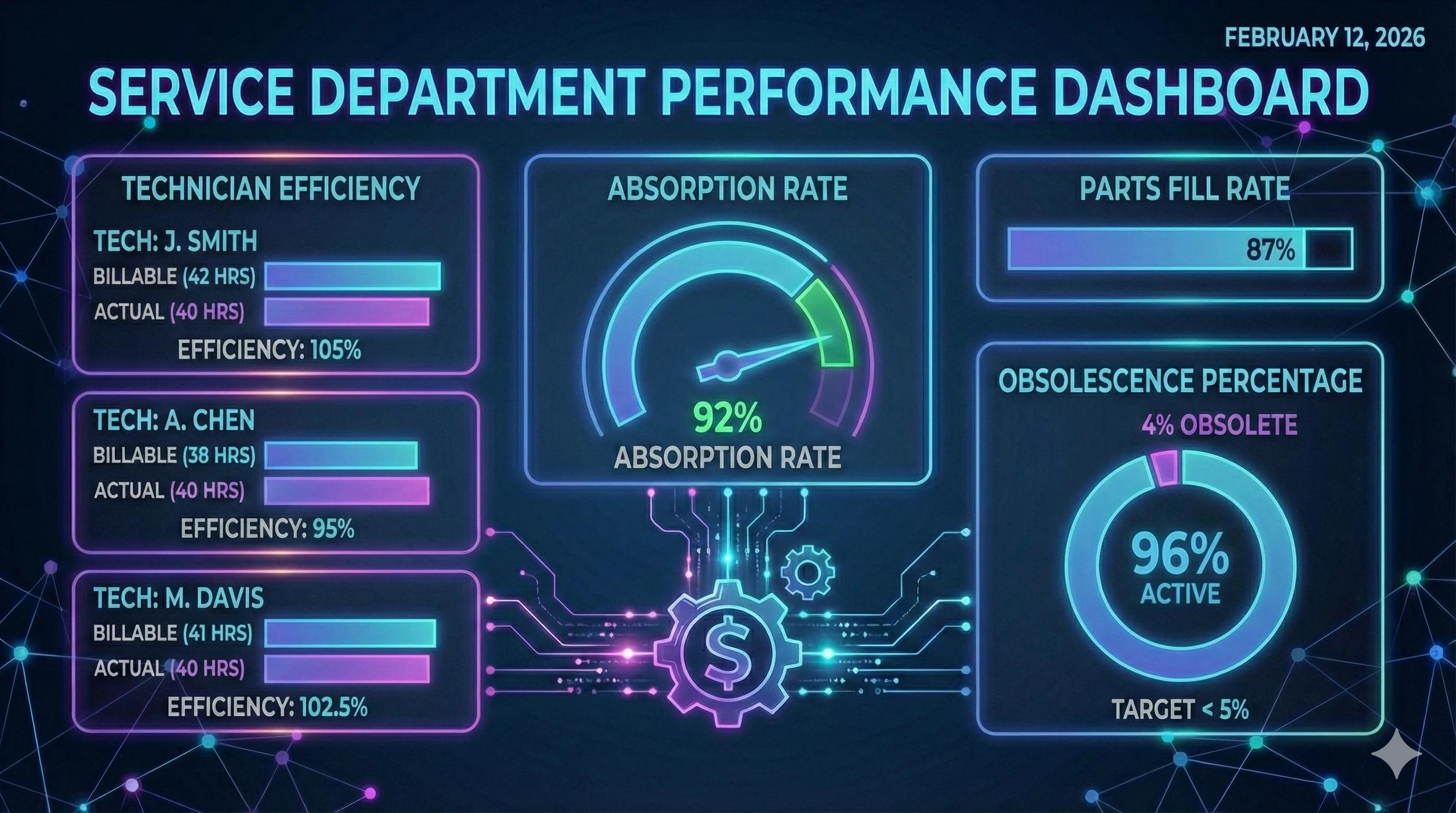
Service Absorption Rate (Does Service Cover 100% of Fixed Costs?)
What it measures: The percentage of your dealership's total fixed costs (rent, utilities, salaries, insurance) covered by gross profit from service and parts departments.
Why it matters: If service and parts generate enough gross profit to cover all fixed costs, every unit you sell is pure incremental profit. This is the holy grail metric for dealership financial health.
2026 benchmarks:
- Excellent: 100%+ absorption (service/parts cover all fixed costs)
- Good: 80-100% absorption
- Needs improvement: 60-80% absorption
- Problem: <60% absorption
How to improve: Focus on increasing service appointment volume through proactive customer outreach, expand service hours to capture more appointments, train technicians on accessory installation and upselling, and optimize parts margins. Many dealers undercharge for specialized powersports service—review your labor rates against market competitors.
Billable vs. Actual Hours (Technician Efficiency)
What it measures: The ratio of hours billed to customers versus actual clock hours technicians spend working.
Why it matters: A technician who works 8 hours but only generates 4 billable hours represents massive lost productivity. Improving this ratio directly increases service department profitability without adding staff or bays.
2026 benchmarks (billable hours per 8-hour shift):
- Excellent: 7.0-8.0 hours billed
- Good: 6.0-7.0 hours billed
- Needs improvement: 5.0-6.0 hours billed
- Problem: <5.0 hours billed
How to improve: Reduce administrative time with digital repair orders, minimize parts counter trips through integrated parts lookup, implement job clock-in/clock-out tracking to identify inefficiencies, and maintain realistic flat-rate labor guides. Your DMS should show technician efficiency by individual and by job type to identify coaching opportunities.
Parts Fill Rate and Obsolescence Percentage
What it measures:
- Fill rate: Percentage of parts requested that you have in stock
- Obsolescence: Percentage of parts inventory that hasn't moved in 12+ months
Why it matters: High fill rates drive service department efficiency and customer satisfaction—technicians can complete jobs without delays, customers don't wait for special orders. But overstocking leads to obsolete inventory tying up capital and eventually requiring write-downs.
2026 benchmarks:
- Fill rate: 85-90% (excellent), 75-85% (good)
- Obsolescence: <5% (excellent), 5-10% (good), >15% (problem)
How to improve: Use DMS analytics to identify fast-moving parts and ensure adequate stock levels, leverage OEM supersession updates to avoid ordering discontinued parts, return slow-moving parts under manufacturer return programs, and implement min/max inventory thresholds based on historical demand data. Machine learning-enhanced systems can predict seasonal demand patterns automatically.
Category C: Sales & F&I
While service and parts drive long-term profitability, sales obviously remain critical. But the key sales KPIs aren't about volume—they're about speed and profitability per transaction.
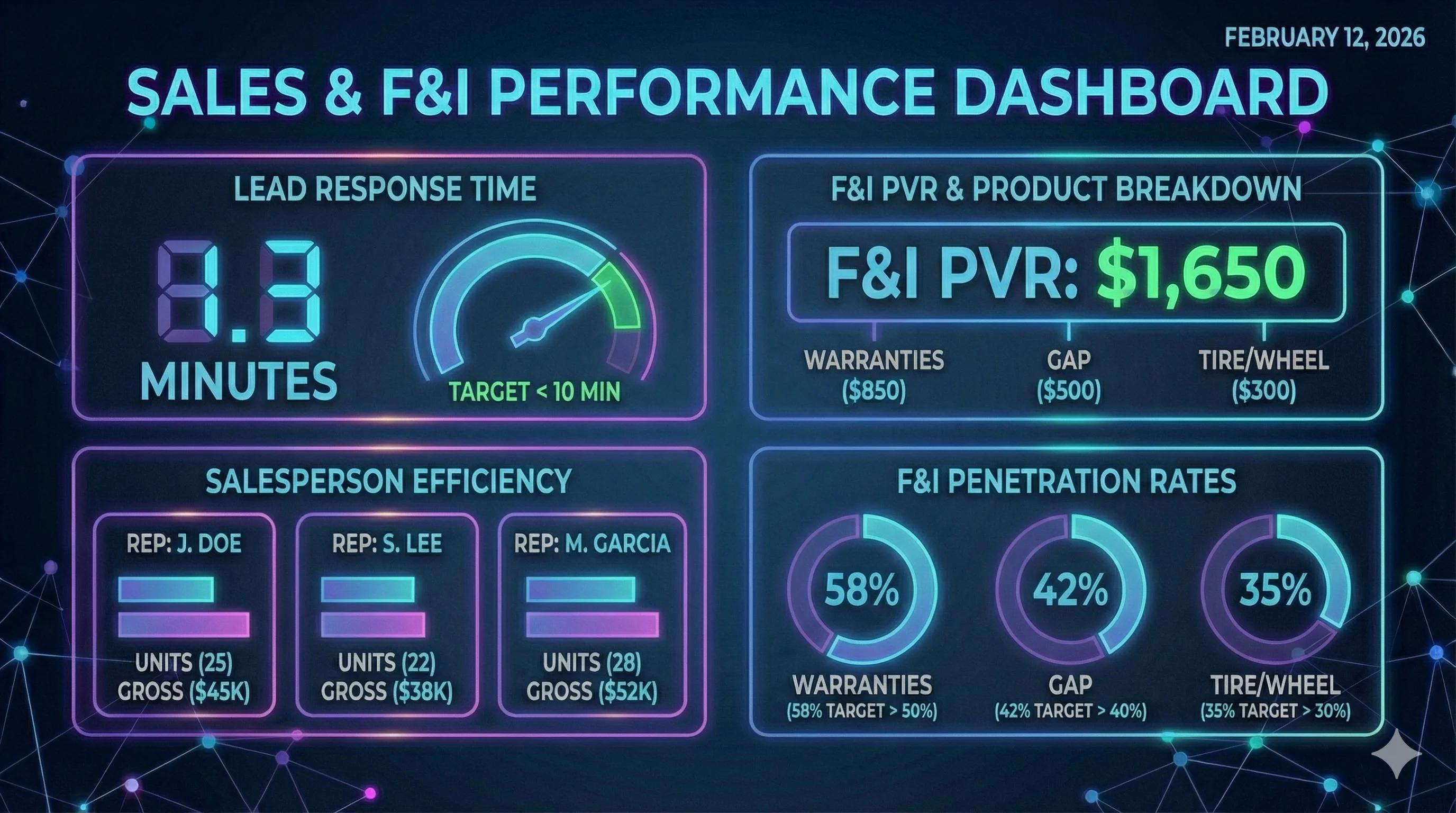
Lead Response Time (Target: <10 Minutes)
What it measures: The time elapsed between when a lead arrives (website inquiry, phone call, chat message) and when a salesperson makes contact.
Why it matters: Industry data consistently shows that response time directly correlates with close rates. Leads contacted within 10 minutes are 4x more likely to convert than those contacted after an hour. In competitive markets, the fastest responder wins the customer.
2026 benchmarks:
- Excellent: <10 minutes average response time
- Good: 10-30 minutes
- Needs improvement: 30-60 minutes
- Problem: 60+ minutes or inconsistent follow-up
How to improve: Implement automated lead distribution and alerts via mobile push notifications, use CRM automation to trigger immediate text message responses acknowledging inquiries, establish clear accountability with lead response tracking by salesperson, and consider AI-powered chatbots for after-hours initial response. Modern powersports dealer management software includes these capabilities out of the box.
F&I Back-End Profit Per Unit (PVR)
What it measures: Average profit from finance reserve, extended warranties, tire/wheel protection, gap insurance, and other F&I products per unit sold.
Why it matters: With compressed front-end gross profit, F&I penetration often represents 40-60% of total unit profitability. Dealerships that excel at F&I consultation rather than sales pressure generate significantly higher PVR while maintaining customer satisfaction.
2026 benchmarks (per unit sold):
- Excellent: $1,800-$2,500+ PVR
- Good: $1,200-$1,800 PVR
- Needs improvement: $800-$1,200 PVR
- Problem: <$800 PVR
How to improve: Train F&I managers on consultative selling techniques, use menu presentation tools that make product value clear, ensure sales staff pre-qualify customers on payment expectations before reaching F&I, track product penetration rates (not just PVR) to identify gaps, and integrate digital retailing so customers can explore F&I products online before arriving. Transparency drives conversion.
2026 KPI Benchmarks Table (What "Good" Looks Like by Dealership Size)
Performance expectations vary based on dealership size and market. Use these segmented benchmarks to set realistic targets:
Small Dealerships (10-50 units sold/month)
| KPI | Excellent | Good | Needs Work |
|---|---|---|---|
| Days-to-Line | 2-3 days | 4-5 days | 6+ days |
| Unit Turn Rate | 6-8x/year | 4-6x/year | <4x/year |
| Aged Inventory (60+) | <15% | 15-25% | >25% |
| Service Absorption | 80-100% | 60-80% | <60% |
| Technician Efficiency | 6-7 hrs/day | 5-6 hrs/day | <5 hrs/day |
| Parts Fill Rate | 80-85% | 70-80% | <70% |
| Lead Response Time | <15 min | 15-30 min | >30 min |
| F&I PVR | $1,200+ | $800-$1,200 | <$800 |
Medium Dealerships (50-150 units sold/month)
| KPI | Excellent | Good | Needs Work |
|---|---|---|---|
| Days-to-Line | 2-3 days | 3-4 days | 5+ days |
| Unit Turn Rate | 7-9x/year | 5-7x/year | <5x/year |
| Aged Inventory (60+) | <12% | 12-20% | >20% |
| Service Absorption | 90-110% | 70-90% | <70% |
| Technician Efficiency | 6.5-7.5 hrs/day | 5.5-6.5 hrs/day | <5.5 hrs/day |
| Parts Fill Rate | 85-90% | 75-85% | <75% |
| Lead Response Time | <10 min | 10-20 min | >20 min |
| F&I PVR | $1,500+ | $1,000-$1,500 | <$1,000 |
Large Dealerships (150+ units sold/month)
| KPI | Excellent | Good | Needs Work |
|---|---|---|---|
| Days-to-Line | 1-2 days | 2-3 days | 4+ days |
| Unit Turn Rate | 8-10x/year | 6-8x/year | <6x/year |
| Aged Inventory (60+) | <10% | 10-15% | >15% |
| Service Absorption | 100-120% | 80-100% | <80% |
| Technician Efficiency | 7-8 hrs/day | 6-7 hrs/day | <6 hrs/day |
| Parts Fill Rate | 88-92% | 80-88% | <80% |
| Lead Response Time | <5 min | 5-15 min | >15 min |
| F&I PVR | $2,000+ | $1,500-$2,000 | <$1,500 |
Important note: These benchmarks represent general guidelines. Geographic market, brand mix, and business model (new vs. used focus, service vs. sales emphasis) significantly impact achievable targets. Use these as starting points and refine based on your specific circumstances.
How Your DMS Should Automate These Reports So You Stop "Guessing"
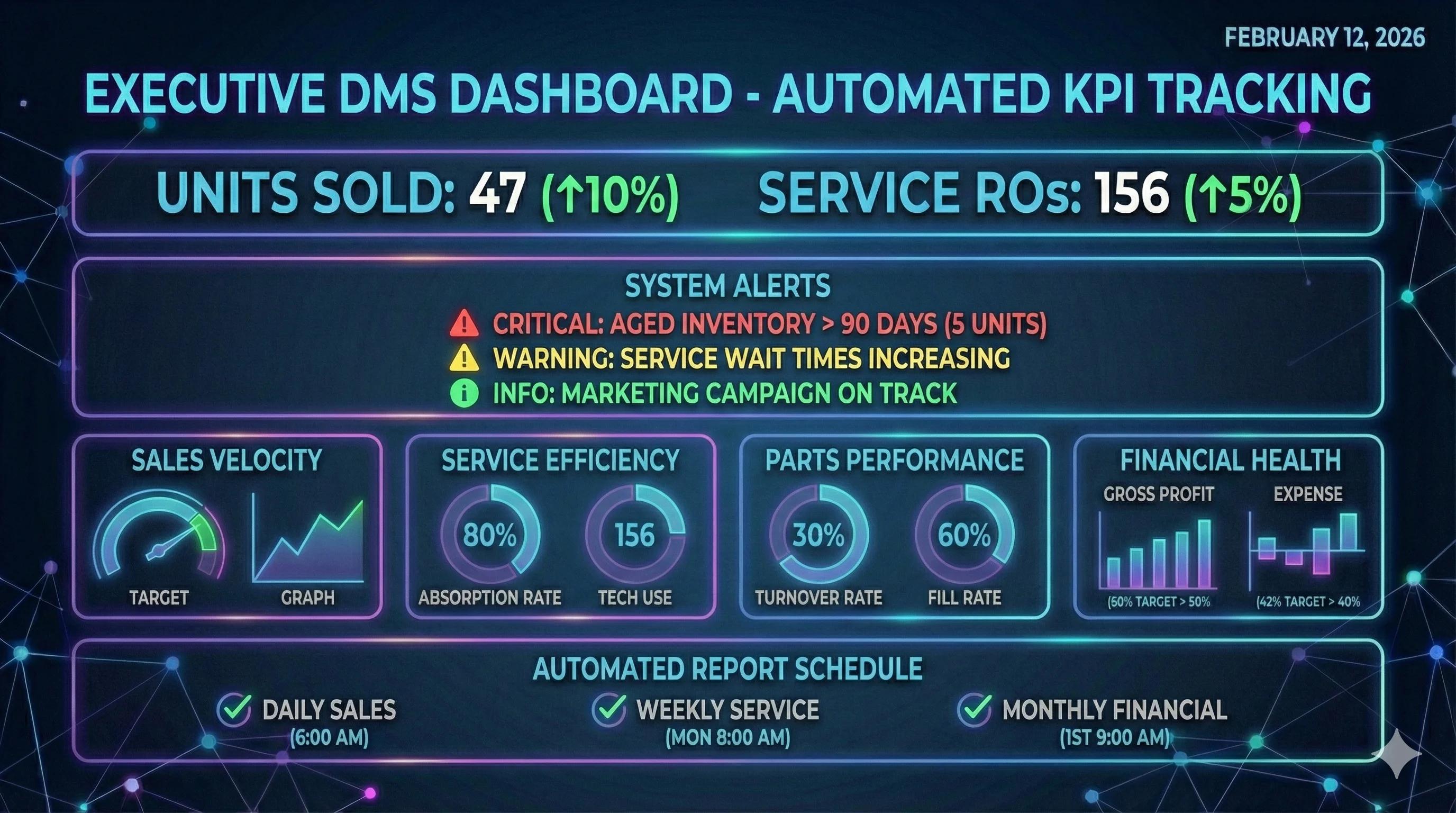
Tracking these KPIs manually through spreadsheets is unsustainable and error-prone. Modern powersports dealer management software automates KPI tracking and reporting, transforming data into actionable insights without requiring constant manual effort.
Real-Time Dashboards, Not Monthly Reports
The most effective DMS platforms provide role-specific dashboards that update in real-time:
- General Manager: High-level overview of all KPI categories with trend lines and benchmark comparisons
- Sales Manager: Lead response times, conversion rates, inventory aging by salesperson
- Service Manager: Technician efficiency, open ROs, service absorption trending
- Parts Manager: Fill rates, obsolescence alerts, fast-mover stock levels
- F&I Manager: PVR by product type, penetration rates, lender approval rates
These dashboards should be accessible on mobile devices, allowing managers to monitor performance from anywhere without logging into desktop terminals.
Automated Alerts for KPIs Trending Out of Range
Rather than requiring daily report reviews, sophisticated DMS systems send proactive alerts when metrics exceed defined thresholds:
- Inventory aging: Alert when specific units reach 30, 45, 60 days
- Lead response: Notification when leads go 10+ minutes without contact
- Service capacity: Warning when scheduled appointments reach 90% of bay capacity
- Parts stock-outs: Alert when fast-moving parts fall below minimum stock levels
- Technician productivity: Notification when efficiency drops below target for consecutive days
These alerts enable proactive management intervention before small issues become major problems.
Historical Trending and Seasonal Comparison
Understanding whether current performance is improving or declining requires historical context. Quality DMS reporting includes:
- Year-over-year comparison: Compare this February's metrics to last February's, accounting for seasonality
- Trailing 12-month trends: Smooth out seasonal variation to see true directional trends
- Goal tracking: Visual indicators showing progress toward established targets
- Benchmark comparison: Optional integration with industry data providers to compare your performance against similar dealerships
This historical perspective transforms KPIs from snapshots into strategic tools for continuous improvement.
Integration With Existing Business Intelligence Tools
While DMS-native reporting handles most needs, larger dealerships often use dedicated business intelligence platforms (Power BI, Tableau, etc.). Modern powersports DMS software provides:
- API access for automated data extraction
- Pre-built data warehouse schemas optimized for analytics
- Scheduled exports to cloud storage or BI platforms
- Real-time data streaming for mission-critical metrics
This flexibility ensures your DMS can grow with your analytical sophistication rather than becoming a constraint.
Conclusion: From Data to Decisions
The dealerships winning in 2026's competitive powersports market aren't just collecting data—they're transforming metrics into action. By focusing on the velocity KPIs that actually predict profitability rather than vanity metrics that look good in presentations, you create a performance culture grounded in operational excellence.
The right metrics reveal exactly where to focus improvement efforts: If service absorption is low, prioritize technician training and appointment volume. If aged inventory is high, adjust pricing strategies and stocking decisions. If lead response time is slow, implement mobile alerts and accountability systems.
But tracking these KPIs manually is a losing battle. Modern powersports dealer management software automates the entire measurement and reporting process, freeing your team to focus on improvement rather than data collection. Real-time dashboards, automated alerts, and historical trending transform KPI tracking from a monthly chore into a daily operational advantage.
Ready to transform your dealership with automated real-time KPI reporting?
Frequently Asked Questions (FAQs)
What's the single most important KPI for powersports dealership profitability?
While no single metric tells the whole story, service absorption rate is often the most predictive of overall dealership health. If your service and parts departments generate enough gross profit to cover 100% of your fixed costs, every unit sale becomes pure incremental profit. This metric reflects pricing strategy, operational efficiency, customer loyalty, and market positioning all in one number.
How often should I review dealership KPIs?
Weekly reviews are the minimum for operational KPIs like inventory aging, lead response time, and technician efficiency. Monthly reviews work for higher-level metrics like service absorption and annual turn rates. However, your DMS should provide real-time dashboards so managers can spot issues immediately rather than waiting for scheduled review meetings. Daily visibility enables proactive management rather than reactive firefighting.
Why is my inventory turn rate lower than benchmarks?
Low inventory turn rates typically result from one or more factors: overpricing relative to market (check competitive listings for comparable units), stocking the wrong mix (analyze which categories are slow-moving vs. fast-moving), poor merchandising (low-quality photos, incomplete descriptions, no online visibility), seasonal mismatch (heavy marine inventory during winter), or excessive aged inventory (units sitting 90+ days drag down overall turn rate). Use your DMS aging reports to identify specific problem units and categories.
How can I improve technician billable hours without adding staff?
Focus on reducing non-productive time: implement digital RO workflows to minimize paperwork, integrate parts lookup so technicians don't make multiple trips to the parts counter, schedule appointments strategically to avoid gaps between jobs, maintain realistic flat-rate labor times that allow completion without excessive time, and track clock-in/clock-out by job to identify specific inefficiency sources. Many dealerships discover 1-2 hours per day are lost to administrative friction rather than actual technical work.
Should I track the same KPIs for each product line separately?
Yes—segment-level analysis is crucial for accurate performance assessment. ATVs, street motorcycles, marine units, and scooters have fundamentally different turn rate expectations, margin structures, and service requirements. Averaging them together masks important trends. Your DMS should allow filtering and comparison by product line, helping you identify which categories drive profitability and which need attention.
How does DealerClick help with automated KPI tracking and reporting?
DealerClick's powersports dealer software provides real-time dashboards tracking all major KPI categories covered in this article—inventory velocity, service efficiency, parts performance, and sales metrics. The platform automatically generates role-specific reports, sends alerts when metrics exceed thresholds, and integrates with business intelligence tools for advanced analytics. Rather than spending hours building spreadsheets, dealers access current performance data instantly from any device, enabling data-driven decision-making without administrative burden.
Stay Updated
Get the latest auto dealer insights delivered straight to your inbox.
No spam. Unsubscribe anytime.