How to Launch a Lease Here Pay Here Dealership
Plan, license, and market a lease-here-pay-here operation that balances high demand with compliance and risk control.
Lease Here Pay Here (LHPH) combines elements of leasing and in-house financing: you maintain ownership of the vehicle while allowing customers—often with challenged credit—to drive it for a fixed payment over time. Done right, LHPH creates recurring revenue, better asset control, and credit-building opportunities for your customers. Done poorly, it piles up defaults, legal issues, and reputational damage. Use this guide to build an LHPH program with strong foundations, then explore our rent-to-own guide and state compliance checklist to round out your strategy.
The Problem
- Traditional lenders rarely approve customers with credit challenges, yet demand for reliable transportation remains high.
- Lease laws and consumer protection rules vary by state, making compliance complex.
- Managing risk (vehicle depreciation, delayed payments, repossessions) requires specialized processes.
- Sales, collections, and service teams need systems built for recurring payments and asset tracking.
- Marketing must educate the community and overcome skepticism about alternative financing.
The Solution
Create a structured LHPH program: research regulations, secure funding and insurance, build operations and technology, design customer-friendly lease terms, and market the program transparently. DealerClick’s LHPH software unifies inventory, contracts, collections, and CRM so you can scale with confidence.
Key Benefits
- Serve an underserved audience while controlling vehicles and cash flow.
- Generate recurring revenue with predictable lease payments.
- Offer credit-building opportunities that create loyal, repeat customers.
- Maintain higher-quality inventory by reclaiming vehicles at lease end.
- Use data to refine underwriting, collections, and marketing over time.
States with heavy LHPH activity—Texas, Florida, California, and North Carolina—layer additional lease disclosures, tax nuances, and repossession procedures on top of federal rules. Keep those linked state pages handy as you build the playbook below so your contracts, marketing language, and APR guardrails match local expectations.
1. Research Market Demand & Regulations
Assess demand by analyzing credit scores, income levels, and transportation needs in your region. Interview community organizations, employers, and existing customers to understand payment expectations and vehicle preferences. Study competitors (BHPH, rent-to-own, traditional leases) to identify gaps you can fill, such as flexible mileage or bundled maintenance packages. Investigate state-specific lease laws—some treat LHPH as retail installment contracts, others as consumer leases. Document disclosure requirements, APR caps, repossession procedures, and licensing rules, and consult an attorney who specializes in automotive finance to craft compliant contracts.
2. Secure Capital, Insurance, and Facilities
Estimate startup costs: inventory acquisition, reconditioning, leasing office upgrades, software, staffing, marketing, and reserves for defaults. Secure funding via bank lines, private investors, or floorplan lenders comfortable with LHPH portfolios; emphasize collateral control, GPS technology, and proven underwriting criteria in your pitch. Obtain required insurance (garage liability, lender’s single interest, fidelity bonds) and consider optional coverage like skip-tracing support or guaranteed asset protection. Choose a lot with secure parking, alternate storage for repossessed units, and space for on-site servicing so you can maintain vehicles efficiently.
3. Build Operations, Team, and Technology
Hire specialists: sales reps versed in credit-challenged customers, collections agents who balance empathy with firmness, service techs who keep lease units in top shape, and compliance managers who monitor regulations. Draft SOPs for underwriting, inspections, repossession, and customer service. Implement DealerClick Lease Here Pay Here Software to manage inventory, contracts, payment schedules, insurance tracking, collections workflows, GPS data, and CRM in one place. Integrate accounting and marketing tools so data flows automatically rather than via spreadsheets.
4. Design Customer-Centric Lease Programs
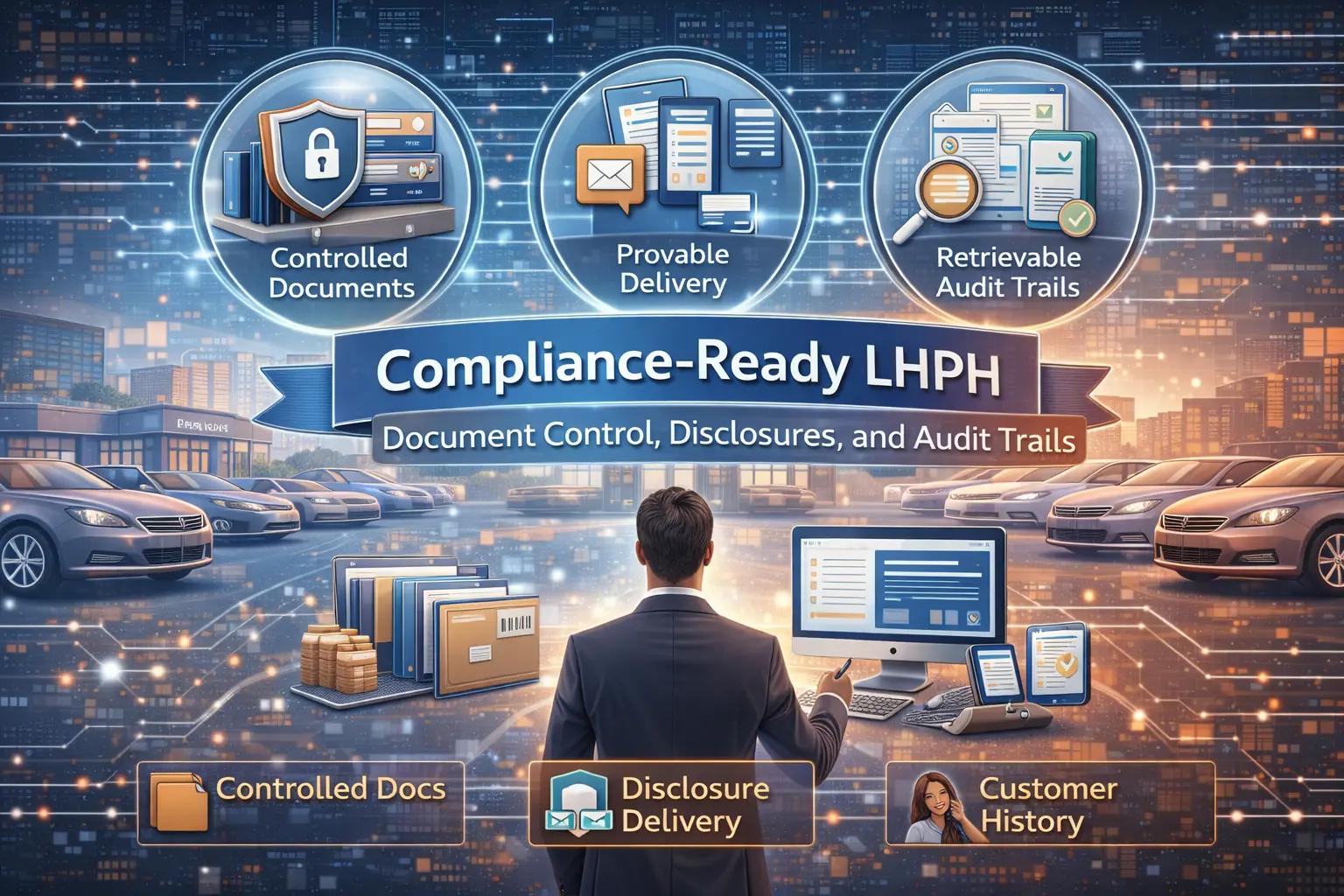
Set lease terms that align with your market: payment frequency (weekly, bi-weekly, monthly), mileage allowances, down payments, and end-of-term options (buyout, upgrade, return). Offer tiered plans based on vehicle segment or risk profile, and bundle maintenance plans or insurance where allowed to protect assets. Create transparent disclosure packets with plain-language explanations of total cost, late fees, damage policies, GPS use, and repossession triggers. Train staff to explain credit-building benefits and responsibilities clearly—education reduces defaults and builds trust.
5. Manage Risk & Collections Proactively
Use standardized scorecards that evaluate employment stability, residence history, references, and prior auto credit. Require proof of insurance and enforce coverage with automated reminders or vendor partnerships. Install GPS/immobilizers when permitted to aid recovery while following state privacy laws. Implement proactive collections: automated payment reminders, early outreach on missed payments, and hardship programs. Track delinquency KPIs weekly inside DealerClick and adjust underwriting or payment schedules if defaults rise. Maintain relationships with repossession agents and auction partners for efficient asset recovery.
6. Launch Marketing & Community Outreach
Educate the community about LHPH benefits via your website, blog posts, social media, and local events. Highlight success stories (with permission) and explain how timely payments rebuild credit. Partner with employers, military bases, churches, and nonprofits that serve customers needing reliable transportation quickly. Run geo-targeted ads focusing on “credit rebuilding leases” rather than “bad credit,” and align messaging with the geographic insights from our marketing audit. Ensure all marketing materials disclose relevant lease terms to stay compliant.
LHPH Launch Checklist
| Stage | Key Actions | DealerClick Support |
|---|---|---|
| Research | Market demand, legal review, competitor analysis | Reporting & data import |
| Capital & insurance | Funding, insurance policies, facility prep | Document storage |
| Operations setup | Hiring, SOPs, technology integration | Contracts, collections, CRM |
| Program launch | Lease terms, marketing campaigns, partnerships | Lead tracking & automation |
Real-World Example
A Florida dealership added LHPH to complement its BHPH program. After researching state lease laws and securing a $2M credit facility, they piloted with 40 vehicles equipped with GPS and maintenance bundles. Using DealerClick for contracts, collections, and CRM, they kept delinquency under 6% and recovered 95% of vehicles at lease end, allowing profitable re-leasing or sales. Community workshops on credit rebuilding generated referrals, and transparent marketing improved reputation, leading to 30% year-over-year growth in the LHPH portfolio.
Location-specific LHPH resources
- Texas dealer software: Auto-build bilingual lease packets, enforce OCCC disclosures, and track 254-county tax rules for large portfolios.
- Florida dealer software: Tie DHSMV e-services, hurricane continuity plans, and surtax calculators into every lease workflow.
- California dealer software: Manage Rees-Levering and Song-Beverly disclosures alongside CARB and CDTFA tax automation for LHPH assets.
- North Carolina dealer software: Align Highway Use Tax, ELT submissions, and 20-day tag tracking with lease renewals and repossessions.
Conclusion
Lease Here Pay Here can be a powerful addition to your dealership’s finance offerings, but it demands discipline in planning, compliance, and customer education. With clear processes and DealerClick’s LHPH software, you can create a sustainable program that helps customers while protecting your bottom line. Ready to plan your LHPH launch? We’re here to help.
Frequently Asked Questions
How much inventory do I need to start?
Many dealers pilot with 25–50 vehicles across popular segments (sedans, SUVs, trucks). Start small, refine underwriting, then scale once KPIs (delinquency, repossession rate, recovery value) stabilize.
How do I report payments to credit bureaus?
Work with a credit reporting service or integrate DealerClick’s reporting module so on-time payments help customers rebuild credit. Ensure you have customer consent and follow FCRA guidelines.
Stay Updated
Get the latest auto dealer insights delivered straight to your inbox.
No spam. Unsubscribe anytime.